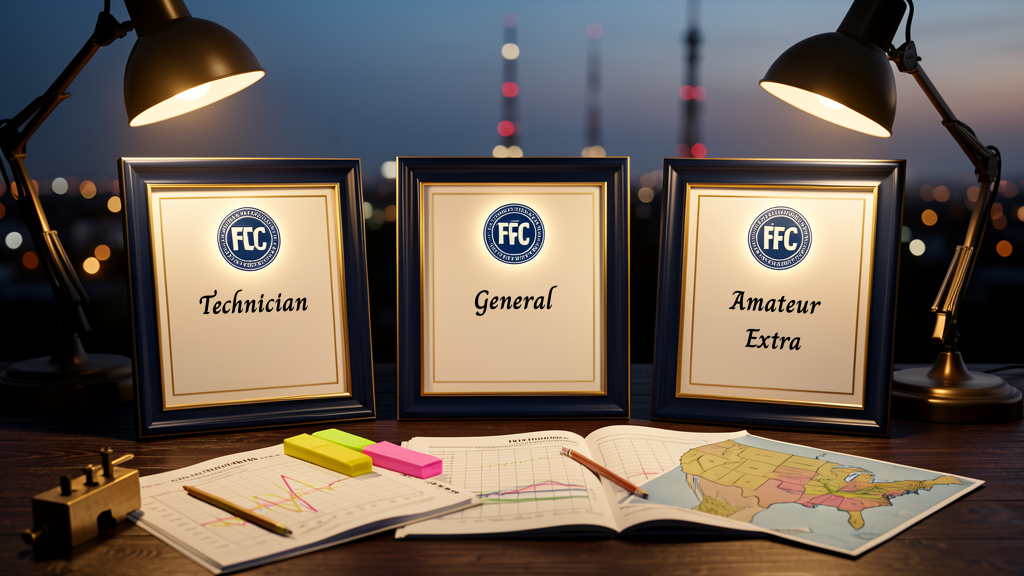
Getting your ham radio license can feel like a big step. There’s an exam, three different license levels, and a lot of unfamiliar rules. But here’s the thing — it’s more straightforward than it looks, and the payoff is worth it.
This guide breaks down the three ham radio license classes, what each one actually lets you do on the air, and how to prepare for your first exam.
Why Get a Ham Radio License at All?
If you’re researching this, you probably already have a reason. But let me be specific about what separates ham radio from FRS walkie-talkies or GMRS radios you can buy at any sporting goods store:
- Much more power. Handheld ham radios typically put out 5-10 watts. FRS maxes out at 2 watts. That difference is real — you’ll reach farther and sound clearer.
- Access to repeaters. These are stations that sit on hilltops and mountains, catching your signal and rebroadcasting it across wider areas. A 5-watt handheld hitting a good repeater can reach hundreds of miles.
- Digital modes. FT8, JS8, DMR, Fusion — these let you make contacts around the world with modest antennas and modest power.
- Your own call sign. It’s a real identifier — something like KD0JYV — that follows you across every radio you operate.
The catch: you need a license from the FCC. The good news is the entry-level Technician class exam is 35 multiple-choice questions, and with the right prep you can pass it in a few weeks of studying.
The Three License Classes — What They Actually Mean
Technician Class — Entry Level
Exam: 35 questions, 26 correct to pass
Privilege: VHF/UHF bands + limited HF privileges
Technician is where everyone starts. It gives you full access to the VHF and UHF bands — the frequencies most handheld and mobile radios use. This is primarily local traffic in and around your city or county.
On VHF/UHF, you’ll be primarily using:
- 2-meter band (144-148 MHz) — the most popular ham band, great for local contacts and repeater work
- 70-centimeter band (420-450 MHz) — higher frequencies, good for urban areas and building penetration
You also get a small but real slice of HF privileges — enough to get on parts of 10 meters with voice/data/CW, and parts of 15, 40 and 80 meters with CW only. It’s not enough for serious DX (unless you use CW) but it’s enough to make some contacts and see if you like working with the HF bands.
General Class — Intermediate
Exam: 35 questions, 26 correct to pass (requires passing Technician first)
Privilege: All VHF/UHF + most HF bands
General opens the door to most of the HF (high-frequency) bands — the ones that bounce signals off the ionosphere and let you talk around the world. This is where ham radio gets really interesting if you want to make some international contacts, do POTA, SOTA or chase after awards. This is what people usually picture in their minds when they think of ham radio.
With a General ticket you get voice access to most of the popular HF bands:
- 80 meters, 40 meters, 20 meters, 17 meters, 15 meters, 12 meters, and 10 meters
- A selection of digital mode sub-bands on HF
Most hams who stay active eventually upgrade to General. It’s the sweet spot between privilege and exam difficulty.
Amateur Extra Class — Top Level
Exam: 50 questions, 37 correct to pass (requires passing General first)
Privilege: Full access to all amateur bands
Amateur Extra is the full license. You get access to every single band and frequency allocated to ham radio in the US, including the remaining sub-bands that only Extra-class operators can use on HF.
For most casual hams, General is plenty. But if you want to be on the cutting edge of HF digital modes, experiment with all the available frequencies, or pursue competitive operating awards, Extra is the way to go.
Quick Comparison Table
| Feature | Technician | General | Extra |
|---|---|---|---|
| VHF/UHF (local/regional) | Full access | Full access | Full access |
| HF (long distance) | Limited (some voice/CW/digital) | Most bands, most modes | All bands, all modes |
| Exam questions | 35 | 35 | 50 |
| Passing score | 26/35 | 26/35 | 37/50 |
| Exam parts | 3 | 4 | 5 |
| Study time (avg) | 2-4 weeks | 2-4 weeks | 4-8 weeks |
| Best for | Local comms, repeaters, satellites, emergency comms | DXing, HF voice/digital, POTA, SOTA | Full spectrum access, competitive operating |
What Each License Costs
The exam fee is set by the volunteer exam session coordinator — it’s typically $15. That’s it for the actual test. There’s also a $35 FCC filing fee to get your license.
After you pass, the FCC issues your call sign via email. Your first license term runs for 10 years, and renewal costs $35.
How Long Does It Take to Get Licensed?
For most people:
- Technician: 2 to 4 weeks of focused study
- General: Another 2 to 4 weeks after Technician
- Extra: 4 to 8 weeks for experienced hams
You can take multiple exams in sequence at a single exam session if you’re prepared — some hams do this to save time and study work. The FCC doesn’t require you to hold each class for any minimum time before upgrading…you just have to pass the tests in order.
What’s Actually on the Technician Exam?
The Technician exam covers three areas:
- Regulations — FCC rules, operating practices, prohibited transmissions
- Operating practices — how to call CQ, use repeaters, handle emergencies
- Radio basics — electrical principles, antenna types, feed lines, propagation basics
No advanced electronics or math. The questions are practical — “which of these frequencies is in the 2-meter band?” and “what does a repeater do?”
Should You Start With Technician Only or Go For Technician and General In the Same Session?
The most common recommendation is to start with Technician. Here’s why:
- It gives you a real foundation — you’ll learn the basics on the bands where most activity happens (VHF/UHF)
- You can get on the air quickly while studying for the next level
- The questions build on each other — Technician prepares you for General
- Passing Technician first gives you momentum
But, if you’re ambitious and want to put in a little extra study time, you can take BOTH the Technician and General exams in the same testing session and get those additional HF privileges right away. This opens up a ton of activities and options for you like POTA, SOTA, DXing, Contesting and chasing awards. You can do some of that stuff to a limited degree with only a Technician license, but General really opens things up for you. If you have the interest, this is something to consider.

Frequently Asked Questions
What can I do with a Technician Class license?
Technician gives you full access to all VHF and UHF bands (2-meter and 70-centimeter, the most popular bands for handheld and mobile radios) — primarily local and regional traffic in and around your city or county. You also get a limited slice of HF privileges: parts of 10 meters with voice, data, and CW, plus parts of 15, 40, and 80 meters with CW only. It’s enough to make some contacts and explore HF, but not enough for serious DX unless you use CW. The Technician exam is 35 multiple-choice questions, and with focused study most people pass in 2–4 weeks.
What does a General Class license give me that Technician doesn’t?
General opens the door to most of the HF bands — the frequencies that bounce signals off the ionosphere and let you talk around the world. You get voice access to 80 meters, 40 meters, 20 meters, 17 meters, 15 meters, 12 meters, and 10 meters, plus a selection of digital mode sub-bands on HF. This is where ham radio gets really interesting if you want to do POTA, SOTA, DXing, or contesting. The General exam requires passing Technician first, then another 35-question test. Most hams who stay active eventually upgrade to General — it’s the sweet spot between privilege and exam difficulty.
What’s the difference between General and Amateur Extra?
Amateur Extra is the full license — you get access to every band and frequency allocated to ham radio in the US, including the remaining sub-bands on HF that only Extra-class operators can use. The Extra exam is harder: 50 questions versus 35, and a higher passing threshold (37/50 versus 26/35). For most casual hams, General is plenty. But if you want to be on the cutting edge of HF digital modes, experiment with all available frequencies, or pursue competitive operating awards, Extra is the way to go.
How much does it cost to get a ham radio license?
The exam fee is typically $15 — set by the volunteer exam session coordinator. There’s also a $35 FCC filing fee to get your license. After you pass, the FCC issues your callsign via email. Your first license term runs for 10 years, and renewal costs $35. That’s it — no annual fees, no subscriptions.
How long does it take to get licensed?
Most people follow this timeline: Technician — 2 to 4 weeks of focused study. General — another 2 to 4 weeks after passing Technician. Extra — 4 to 8 weeks for experienced hams. You can take multiple exams in sequence at a single testing session if you’re prepared — some ambitious hams do Technician and General together to save time. The FCC doesn’t require you to hold each class for any minimum time before upgrading; you just have to pass the tests in order.
Should I take Technician and General in the same session?
If you’re ambitious and willing to put in a little extra study time, yes — you can take both exams in the same testing session and get your HF privileges immediately. Technician first gives you a real foundation on the bands where most activity happens (VHF/UHF), and passing it gives you momentum. But General really opens things up: POTA, SOTA, DXing, contesting, and chasing awards become fully accessible. You can do some of that with Technician alone, but General makes it significantly more rewarding.
What’s actually on the Technician exam?
Three areas: Regulations — FCC rules, operating practices, prohibited transmissions. Operating practices — how to call CQ, use repeaters, handle emergencies. Radio basics — electrical principles, antenna types, feed lines, and propagation basics. No advanced electronics or math — the questions are practical, like “which of these frequencies is in the 2-meter band?” and “what does a repeater do?”
What equipment do I need as a new Technician licensee?
Start with a handheld transceiver (HT) like a Baofeng UV-5R (under $35) or something from Yaesu, Icom, or Kenwood for more reliability. A programming cable and the free CHIRP software make setting up your radio with local repeater frequencies fast and easy. After you pass Technician and start exploring, you’ll quickly learn what additional gear makes sense for the activities you enjoy most — whether that’s POTA activations, HF digital modes, or contesting.
Your Path Forward
Here’s the roadmap most beginners follow:
- Study for and pass your Technician exam
- Get your first radio — a handheld like a Baofeng UV-5R or something from Yaesu, Icom, or Kenwood
- Find your local repeaters — sites like RepeaterBook.com have databases by location
- Make some contacts — local nets, simplex, and POTA activations are great ways to start
- Upgrade to General when you’re ready for HF
The license is the gate. Once you’re through it, the real fun starts.
Join thousands of new hams who are confidently getting on the air. This practical video series gives you clear solutions to the most common beginner challenges — 100% free with instant access.
Affiliate Disclaimer
Keep in mind that we may receive commissions when you click our links and make purchases. However, this does not impact our reviews and comparisons. We try our best to keep things fair and balanced, in order to help you make the best choice.
As an Amazon Associate, we earn from qualifying purchases.