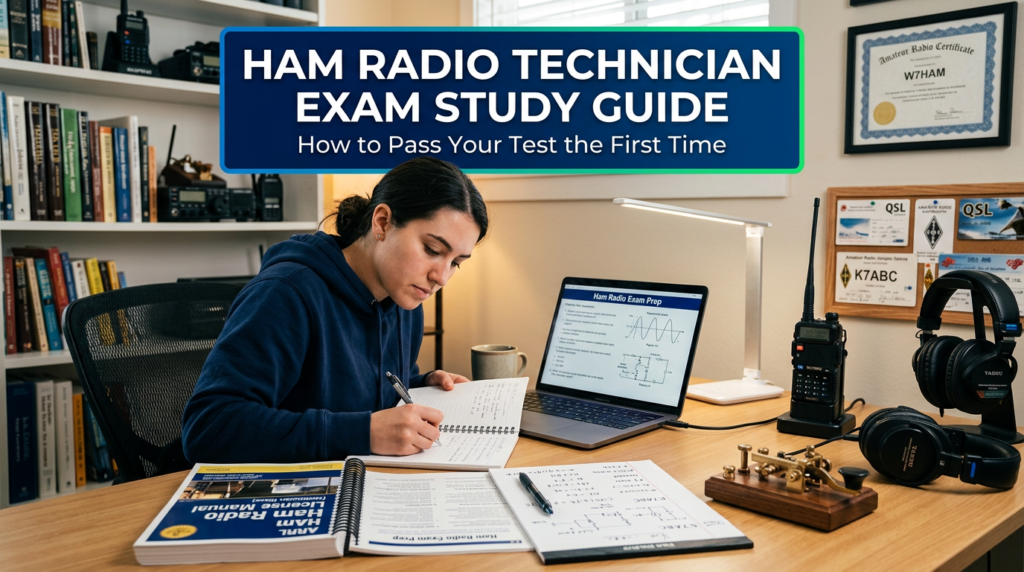
You’ve decided to get your ham radio license. Now comes the question everyone asks: how hard is the ham radio technician exam, really — and what’s the best way to study for it?
Here’s the honest answer: if you put in the work, you’ll pass. The Technician exam is 35 multiple-choice questions. You need 26 correct to pass (74%). The question pool covers basic rules, operating practices, and entry-level electronics — and with focused study, most people are ready in 4–6 weeks.
This guide gives you a complete, no-fluff study framework — from how the exam works to a 4-week prep plan that actually works.
How Hard Is the Technician Exam, Really?
Let’s cut through the anxiety.
The Technician exam — formally called Element 2 — is not a technical knowledge exam. It’s a entry-level licensing exam. It tests:
- Basic FCC rules and regulations
- Operating procedures (how to call CQ, use repeaters, identify properly)
- Radio theory and electronics (power, frequency, antenna basics)
- Safety (electrical, RF exposure)
None of it requires a engineering degree. With the right study materials and a few weeks of consistent effort, most people pass on their first try.
The numbers:
- 35 questions, multiple choice
- 26 correct to pass (74%)
- Usually 10 minutes to complete (more than enough time)
- $15 exam fee at most VE test sessions
The Hidden Advantage Most New Hams Miss
Here’s something most study guides don’t tell you: if you’re serious about ham radio, you should plan to take the Technician AND General exams on the same day.
The General exam (Element 3) unlocks access to all the HF bands — the frequencies that let you talk around the world. Most new Technicians hit a wall within months when they realize they’re limited to local VHF/UHF repeaters and want to get on HF.
The problem is, HF is where the real magic of ham radio lives. And every extra trip back to a VE exam session costs a bunch of study time, another $15 and another scheduling headache.
Why take both exams at once?
- You’re already in study mode. The overlap between Technician and General study material is significant — particularly in rules, regulations, and operating practices. Studying them together is more efficient than studying them twice.
- One exam session, one fee. Pay once, test twice.
- You hit HF immediately after passing.No waiting months to make your first international contact.
- You’re already in the right mindset.Exam-day nerves are real — knock both out at once and you never have to gear up for it again (unless you want to go after your Extra class).
Ham Radio Prep’s video courses work well with this same-day strategy. They cover everything you need for both exams with their Technician + General bundle — so you walk into the VE session confident, prepared, and ready to come out a full General-class operator. Use code HRLaunchpad at checkout for 10% off.
What Topics Are on the Technician Exam?
The question pool is maintained by the National Council of Volunteer Examiner Coordinators (NCVEC). Questions fall into 10 sub-elements:
|
Sub-Element |
Topic |
Approx. Questions |
|
T1 |
FCC Rules and Regulations |
6 |
|
T2 |
Operating Procedures |
6 |
|
T3 |
Radio Equipment and Station Operation |
6 |
|
T4 |
Electrical Principles |
4 |
|
T5 |
Antenna Theory and Design |
4 |
|
T6 |
Propagation |
3 |
|
T7 |
RF Safety |
3 |
|
T3A/T4A/T5A |
Practical Circuits and Components |
3 |
Don’t try to memorize the whole pool. Focus your study on T1 (rules) and T2 (operating procedures) first — those are the highest-yield topics and the most immediately useful once you’re on the air.
The Best Ham Radio Technician Study Resources
Free:
- HamExam.org — free practice exams that pull from the actual NCVEC question pool. Take practice tests daily in your final two weeks. Aim for 5+ consecutive passes in the high 80s before booking your real exam.
- KB6NU’s No-Nonsense Study Guides — free PDF study guides organized by sub-element. Short, direct, no fluff.
- AA9PW.com — online practice exam engine with explanations.
Paid:
- ARRL License Manuals — the official study guide, available in print or digital. Comprehensive but can be a bit dense and technical to read through.
- Ham Radio Prep video courses— Technician + General video courses that supports the same-day exam strategy. Start today and use code HRLaunchpad at checkout for 10% off.
Tip: Use a mix. Video courses for initial learning, books for reference and free practice exams for retention testing.
Your 4-Week Ham Radio Technician Study Plan
This plan assumes 45–60 minutes of study per day, 5 days a week. Adjust based on your schedule.
Week 1–2: Learn the fundamentals
- Watch video course chapters covering T1 (rules) and T2 (operating procedures) first
- Read through KB6NU or ARRL manual, taking handwritten notes on unfamiliar terms
- Do 10–15 practice questions per day from the relevant sub-elements
Week 3: Target your weak spots
- Take a full 35-question practice exam (no time limit)
- Note every question you miss and why
- Spend extra time on T3, T4, T5 if electronics is new to you
- Begin reviewing General exam material if doing same-day strategy
Week 4: Exam simulation
- Take full 35-question practice exams, timed (10 minutes)
- Target 85%+ consistently before booking your real exam
- If doing same-day General, add General-specific review sessions (additional 30–45 min/day)
Book your VE exam when you’re consistently scoring 85%+ on practice tests. Most areas have monthly exam sessions through ARRL or local clubs. Find one at arrl.org/find-an-exam.
What to Bring on Exam Day
- Valid photo ID (driver’s license, passport, or school ID)
- Secondary ID if your primary doesn’t have your name exactly as it appears on your FRN
- FCC Federal Registration Number (FRN) — register free at fcc.gov/ULS before exam day
- $15 cash exam fee (some sessions accept cards — confirm ahead)
- Pencil and simple calculator — some VEs provide calculators; confirm ahead if you need to bring one
After You Pass: What Comes Next
Once you pass, your call sign appears in the FCC Universal Licensing System (ULS) within 1–2 business days. You can start transmitting immediately after that — no waiting for a paper license.
Your first moves:
- Choose your first radio — See our top beginner radio picks for ideas
- Add your local repeaters — repeaterbook.com is the best online directory
- Join a local club — most clubs have nets (weekly on-air meetings) that welcome new hams
- Start participating in the nets — check in and connect with other hams every week
Ready to Pass Both Exams — In One Shot?
If you’re planning to go beyond Technician anyway, save yourself a second trip and a lot of time/work.
The Ham Radio Prep Technician + General course bundle will help you reach that goal: getting you licensed as a full General-class operator in a single VE session. It covers everything — Technician, General, exam strategy, and what to do on exam day.
Start today and use code HRLaunchpad at checkout for 10% off.
Frequently Asked Questions
Join thousands of new hams who are confidently getting on the air. This practical video series gives you clear solutions to the most common beginner challenges — 100% free with instant access.
Affiliate Disclaimer
Keep in mind that we may receive commissions when you click our links and make purchases. However, this does not impact our reviews and comparisons. We try our best to keep things fair and balanced, in order to help you make the best choice.
As an Amazon Associate, we earn from qualifying purchases.