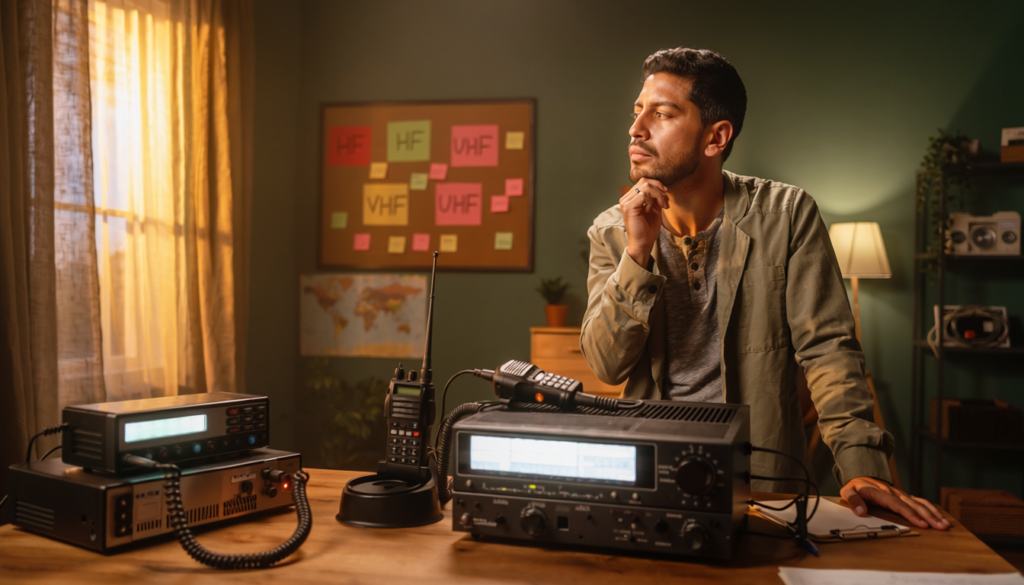
If you’re new to ham radio, you’ve probably noticed that hams talk about HF, VHF, and UHF all the time — and you’re not sure what any of it means. That’s completely normal. The terminology can feel like a foreign language at first. But understanding these three frequency ranges is one of the most important things you can do as a new operator, because it determines who you can talk to, how far your signal can reach, and what kinds of activities you can enjoy.
Let’s break it all down — simply.
First: What Does HF, VHF, and UHF Actually Mean?
These are just labels for different ranges of radio frequencies:
- HF — High Frequency — roughly 3 MHz to 30 MHz
- VHF — Very High Frequency — roughly 30 MHz to 300 MHz
- UHF — Ultra High Frequency — roughly 300 MHz to 3 GHz
You don’t need to memorize the exact numbers. What matters is understanding what each range can do — and that’s determined by how the radio waves behave in the atmosphere.
VHF: The Local Workhorse
VHF covers frequencies from about 30 MHz up to 300 MHz. The most popular ham radio VHF band is the 2-meter band (144 MHz) — it’s the most-used local band in most areas. The 6-meter band (50 MHz) is also popular and occasionally surprises you with long-distance contacts during sporadic-E openings.
VHF signals travel primarily by line-of-sight — meaning they go more or less straight from your antenna to the horizon. On flat ground with no obstructions, that theoretically gives you maybe 10-20 miles of range from a handheld radio (in real-world conditions you may get 1-3 miles of range). But here’s the key: repeaters change everything.
A repeater is a radio relay station placed on a tall tower, hill, or building. It listens on one frequency and retransmits your signal on another — essentially giving your signal a massive range boost. With a repeater, your VHF signal can reach 50, 100, maybe even 200 miles or more depending on the repeater’s location and antenna height.
VHF is where most new Technician class operators spend their time. Local nets, casual contacts with nearby hams, emergency communications, and events like public service activities — all of this happens on VHF. It’s reliable, predictable, and doesn’t require any special conditions to work.
UHF: Urban and Indoor Friendly
UHF covers roughly 300 MHz to 3 GHz. The most popular ham band here is the 70-centimeter band (440 MHz). UHF behaves similarly to VHF in many ways — primarily line-of-sight — but with one key difference: UHF signals handle obstacles like buildings and trees better.
If you’re operating in a city, a forested area, or inside a building, UHF will often outperform VHF. The shorter wavelength punches through urban environments more effectively. This is why many public safety and commercial systems use UHF.
For most ham operators, UHF is less active than VHF for local communications, but it has its niche — especially in urban areas and for specialized applications like linking repeaters together via the internet ( IRLP, Echolink, etc.).
HF: The Bands That Go Around the World
HF is where ham radio gets truly magical. HF frequencies — 3 MHz to 30 MHz — have a unique property: they bounce off the ionosphere, which allows your signal to travel around the curved Earth and reach the other side of the planet.
This is called skywave propagation, and it’s what makes HF different from VHF and UHF in every meaningful way. With 100 watts and a decent antenna, you can talk to someone in Japan, Germany, Australia — anywhere in the world. No internet. No satellites. Just radio waves and the ionosphere.
The tradeoff: HF requires more skill to use effectively. Atmospheric conditions change by hour, season, and solar cycle. Some bands work better during the day, others at night. You’ll learn to read the conditions and adapt (sites like DXLook.com can help). That’s part of what makes HF endlessly interesting.
The major HF ham bands are:
- 80 meters (3.5 MHz) — Nighttime and winter band. Great for regional and domestic contacts at night.
- 40 meters (7 MHz) — Nighttime band with some daytime range. One of the most popular HF bands.
- 20 meters (14 MHz) — The most popular DX band. Works almost any time of day. This is where you’ll find the most activity.
- 15 meters (21 MHz) — Daytime band. Excellent for long-distance contacts when the sun is out.
- 10 meters (28 MHz) — Daytime band, can do worldwide DX. Also the only HF band where Technician class operators have some privileges.
- 6 meters (50 MHz) — Technically VHF, but behaves like HF during certain atmospheric conditions. Called “the magic band” for a reason.
Important: Most HF bands require a General class license or higher. Technician class gives you privileges on 10 meters, 6 meters (VHF), and 2 meters (VHF) — which is mostly local VHF/UHF work. To access the full HF experience — 20 meters to Japan, 40 meters across the continent, 15 meters to Europe — you need General.
So Which Band Should You Use?
Here’s a practical breakdown:
Use VHF when:
- You’re talking locally — within 50-100 miles
- You’re using a handheld or mobile radio
- You want reliable, predictable contacts
- You’re participating in local nets or emergency communications
- You only have a Technician class license
Use UHF when:
- You’re in an urban or heavily wooded area
- You’re operating indoors or need better penetration through buildings
- You’re linking repeaters via internet (IRLP/Echolink)
- Local simplex contacts are your focus
Use HF when:
- You want to talk to operators in other countries
- You’re chasing DX — distant contacts, rare locations
- You’re doing POTA, SOTA, or contesting
- You have a General class license or higher
- You’re willing to learn band conditions and adapt
The Bottom Line
VHF and UHF are your local bands — reliable, consistent, and accessible with a Technician license. HF is your worldwide band — exciting, expansive, and the heart of what makes ham radio unlike anything else. Most operators start on VHF, get their feet wet locally, and then upgrade to General to unlock HF. Once you’ve experienced your first 20-meter contact with Japan, it’s hard to go back to just local VHF.
The good news: you don’t have to choose just one. Your handheld handles VHF and UHF. Your mobile rig does the same, plus more power. And when you’re ready, an HF rig opens the entire world.
Frequently-Asked Questions
What is the difference between HF, VHF, and UHF ham radio bands?
HF (High Frequency) spans approximately 3–30 MHz and primarily uses skywave propagation by bouncing off the ionosphere. VHF (Very High Frequency) ranges from 30–300 MHz (e.g., popular 2-meter band at 144–148 MHz) and relies mainly on line-of-sight. UHF (Ultra High Frequency) covers 300 MHz–3 GHz (e.g., 70-centimeter band at 440 MHz) and also uses line-of-sight but offers better penetration through obstacles such as buildings and foliage.
Which ham radio band should I use: HF, VHF, or UHF?
Choose VHF for reliable local communications (typically 50–100+ miles with repeaters) and easy access with a Technician license. Select UHF for urban, indoor, or heavily wooded environments due to superior obstacle penetration. Use HF for long-distance and international (DX) contacts, though it requires a General class license or higher and awareness of changing propagation conditions.
What are the advantages and disadvantages of HF vs VHF vs UHF in amateur radio?
HF advantages: Enables worldwide contacts with modest power via skywave propagation; ideal for DX, POTA, SOTA, and contesting. Disadvantages: Dependent on ionospheric and solar conditions; requires General or higher license.
VHF advantages: Predictable and reliable for local use; excellent repeater support; accessible with Technician license. Disadvantages: Primarily line-of-sight, limiting range without repeaters.
UHF advantages: Better penetration through buildings and trees in urban settings. Disadvantages: Generally shorter range and less activity than VHF for casual local communications.
Is VHF or UHF better for local ham radio communications?
VHF is generally preferred for most local communications due to its popularity, reliable repeater coverage (often extending 50–200+ miles), and suitability for rural or open areas. UHF performs better in dense urban or indoor environments because its shorter wavelengths penetrate buildings and foliage more effectively, though it tends to have less overall activity.
How does HF enable long-distance or DX contacts in ham radio?
HF enables long-distance and DX (distant station) contacts through skywave propagation, where radio signals reflect off the ionosphere and return to Earth beyond the horizon. This allows global reach—sometimes thousands of miles—with 100 watts and a suitable antenna. Propagation varies by time of day, season, solar cycle, and specific band (e.g., 20 meters often works well for daytime DX).
What ham radio license do I need for HF bands?
A Technician class license provides full access to VHF and UHF bands plus limited HF privileges (primarily on 10 meters and portions of 6 meters). Full access to most HF bands (such as 20 meters, 40 meters, and others ideal for DX) requires a General ▉ (2/2)
How does HF enable long-distance or DX contacts in ham radio?
HF enables long-distance and DX (distant station) contacts through skywave propagation, where radio signals reflect off the ionosphere and return to Earth beyond the horizon. This allows global reach—sometimes thousands of miles—with 100 watts and a suitable antenna. Propagation varies by time of day, season, solar cycle, and specific band (e.g., 20 meters often works well for daytime DX).
What ham radio license do I need for HF bands?
A Technician class license provides full access to VHF and UHF bands plus limited HF privileges (primarily on 10 meters and portions of 6 meters). Full access to most HF bands (such as 20 meters, 40 meters, and others ideal for DX) requires a General class license or higher. An Extra class license offers additional privileges but is not required for basic HF operation.
When should a beginner start with VHF/UHF versus upgrading to HF?
Beginners should start with VHF and UHF bands because they are more predictable, require only a Technician license, and allow immediate local operation using affordable handheld or mobile radios. Once comfortable with local communications and after upgrading to a General class license, transitioning to HF unlocks the excitement of worldwide contacts and more advanced activities.
Ready to unlock the HF bands? The Tech+General Accelerator course walks you through everything you need to pass both exams on the same day and get on the air with full privileges.

Join thousands of new hams who are confidently getting on the air. This practical video series gives you clear solutions to the most common beginner challenges — 100% free with instant access.
Affiliate Disclaimer
Keep in mind that we may receive commissions when you click our links and make purchases. However, this does not impact our reviews and comparisons. We try our best to keep things fair and balanced, in order to help you make the best choice.
As an Amazon Associate, we earn from qualifying purchases.