
What Is Radio Propagation?
If you’ve been on HF for any length of time, you’ve noticed something strange: sometimes you can work Japan on five watts. Other times, you can’t raise anyone across the country on 40 meters at night. That’s propagation doing its thing. Understanding how radio waves travel will make you a better operator. You’ll know when to try 20 meters, when to wait for 40 to open, and why a dipole in a tree sometimes outperforms a rooftop antenna system.
Skip Distance: The Hole in the Middle
Here’s a concept that trips up a lot of new HF operators: there’s a zone where your signal won’t be heard, even though it’s not that far away. Skip distance refers to the minimum distance between your antenna and where your signal first hits the ground after bouncing off the ionosphere. Inside that radius? Dead zone. Your signal shoots up, bounces off the ionosphere, and comes back down hundreds of miles away. The area in between—sometimes a few hundred miles wide—gets nothing.
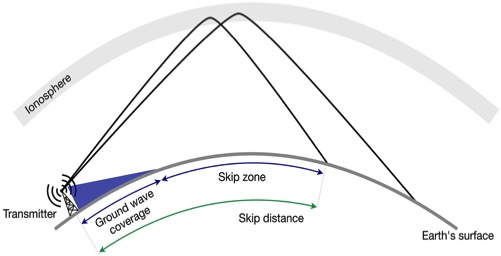
This is why you might hear a station in California clearly but not be able to work one 300 miles away. The ionosphere skipped right over them.
Skip distance changes with frequency. Higher frequencies like 10 meters tend to have larger skip zones — the signal hits the ionosphere at a shallow angle and lands much farther away, so the dead zone in between is wider. Lower frequencies like 40 meters refract back at steeper angles and come down closer in, which makes for a shorter skip. (At the low end, signals can even bounce nearly straight up and back down for solid local coverage.) Knowing your band’s skip characteristics helps you pick the right one for the distance you’re trying to cover.
DX: Talking to the World
DX is ham radio shorthand for “long distance.” A DX contact is generally anything outside your own country, though operators also use it loosely for contacts that stretch across a continent or ocean.
HF is where DXing lives. On a good day with a decent antenna, you can work Japan on 20 meters with five watts. During high solar activity, 10 meters opens up and acts like a local band—you can work continents on a simple wire antenna.
How Each HF Band Behaves
Each HF band has its own personality. Here’s what you need to know:
160 meters (1.8–2.0 MHz) — A night band. It does not work well during the day. At night, it can span oceans, but you’ll fight static all the way. Requires a large antenna system, which makes it impractical for many operators.
80/75 meters (3.5–4.0 MHz) — Primarily a night band, though 75 meters stays open longer than 80. Good for regional contacts out to a few hundred miles. During the day, you’re mostly limited to local contacts.
60 meters (5.3–5.4 MHz) — The oddball. It’s not a normal band — U.S. hams are limited to five specific channels (not a continuous range), USB only (plus some CW/digital), with a power limit of 100 watts effective radiated power. It’s primarily a regional/NVIS band good for in-state and nearby-state contacts, and it sits between 80m and 40m in behavior. Worth a mention but with the channel caveat noted.
40 meters (7.0–7.3 MHz) — The workhorse DX band. Open during the day for regional stuff, and at night it can reach around the world. One of the best all-around bands for a General class license holder.
30 meters (10.1–10.15 MHz) — A WARC band, and a digital/CW-only band by FCC rule: no phone (SSB) allowed, and it’s very narrow (just 50 kHz). It behaves like a hybrid between 40m and 20m — often open day and night, and well-suited to DX on CW and digital modes like FT8. No contests are allowed there, so it stays relatively calm.
20 meters (14.0–14.35 MHz) — The most popular DX band, and the one that’s open more reliably than any other. During daylight it’s dependably good, and in summer or around solar maximum it’ll often stay open well into the night — sometimes around the clock. As the solar cycle winds down it’s more of a daytime band that fades after dark. If you only put up one wire antenna, make it for 20 meters.
15 meters (21.0–21.45 MHz) — Daytime DX band. Opens up strongly when the sun is out, especially during high solar activity. Goes quiet after sunset.
10 meters (28.0–29.7 MHz) — The wild card. During solar maximum, it’s arguably the best DX band in existence—you can work the world on 10 watts with a simple antenna. During solar minimum, it can be completely dead for months. Opens and closes with the solar cycle more dramatically than any other band.
6 meters (50–54 MHz) — Known as “the magic band.” It behaves like HF sometimes and like VHF other times. During good Sporadic E seasons, it lights up and you can work stations hundreds of miles away on what looks like a simple antenna. Unpredictable, but exciting when it opens.
| Band | Best Time | What To Expect |
| 160m (1.8–2.0 MHz) | Night | Ocean-spanning at night, noisy, big antenna needed |
| 80/75m (3.5–4.0 MHz) | Night | Regional out to a few hundred miles |
| 60m (5.3–5.4 MHz) | Night | 5 channels only, USB/data; regional and NVIS work |
| 40m (7.0–7.3 MHz) | Day | Workhorse DX band; regional by day, worldwide at night |
| 30m (10.1–10.15 MHz) | Day & Night | CW/digital only, no phone; quiet DX band |
| 20m (14.0–14.35 MHz) | Day | Most popular and most reliable; best single antenna |
| 15m (21.0–21.45 MHz) | Day | Strong daytime DX, quiet after sunset |
| 10m (28.0–29.7 MHz) | Day (solar-dependent) | Best at solar max, dead at solar min |
| 6m (50–54 MHz) | Varies (Sporadic E) | “The magic band” — unpredictable but exciting |
Day vs. Night: The Ionosphere Changes
The ionosphere isn’t static. The sun ionizes the different layers during the day, and they recombine at night. That changes how each band behaves around the clock.
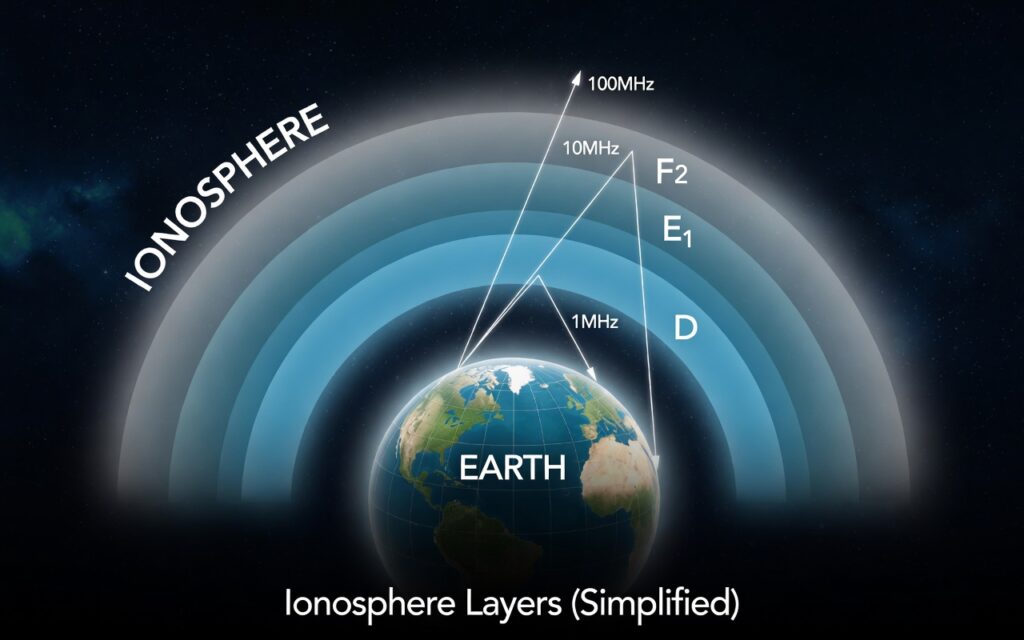
During the day, the D layer absorbs low frequencies (160, 80, and sometimes 40 meters), making them noisy or dead. Higher frequencies punch through fine. After sunset, the D layer fades and the lower bands open up for long-distance work.
This is why experienced HF operators watch the clock. 20 meters is usually best in the afternoon. 40 and 80 meters come into their own after dark. 10 meters is a daytime-only band most of the year—except during solar peaks when it can stay open all night.
The Solar Cycle
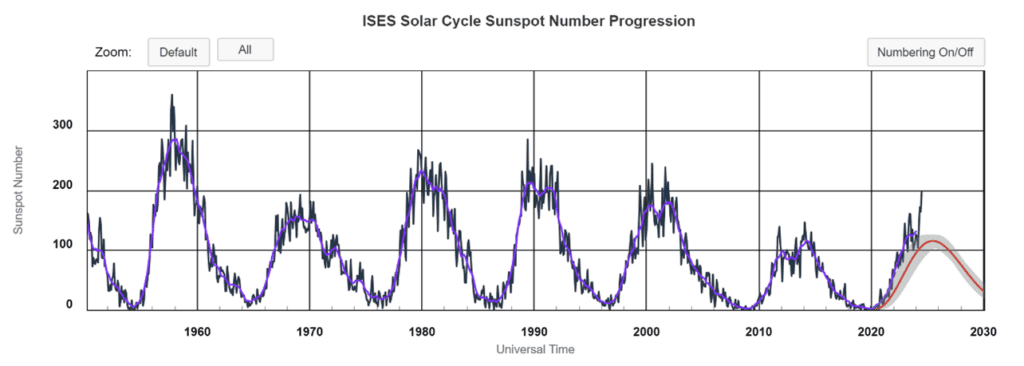
The sun runs on an approximately 11-year cycle. During solar maximum, sunspots are plentiful and the ionosphere is highly ionized. That means better propagation on the higher HF bands (10, 12, 15, 17 meters). During solar minimum, those bands go quiet and the lower bands carry more of the long-distance traffic.
You can check the solar flux index and A-index on websites like SpaceWeather.com to get a sense of current conditions. A solar flux index above 100 generally means good propagation on the higher bands. Below 70, don’t expect much from 10 or 15 meters.
Solar Cycle 25 peaked around 2024 and has been stronger than many predicted. We’re in a good window for HF DX at the time this article is being written.
Paul Herrman (N0NBH) created this solar-terrestrial data panel, and it’s a good resource for the latest band condition info (auto-updates every 3 hours):
Putting It All Together
Propagation isn’t something you master in a weekend. It shifts with the season, the time of day, the sunspot cycle, and factors you can’t control. But once you start paying attention to it—when bands open, when they close, how skip changes—you’ll stop blaming your equipment and start understanding the radio itself.
That’s when it gets fun.
Join thousands of new hams who are confidently getting on the air. This practical video series gives you clear solutions to the most common beginner challenges — 100% free with instant access.
Affiliate Disclaimer
Keep in mind that we may receive commissions when you click our links and make purchases. However, this does not impact our reviews and comparisons. We try our best to keep things fair and balanced, in order to help you make the best choice.
As an Amazon Associate, we earn from qualifying purchases.