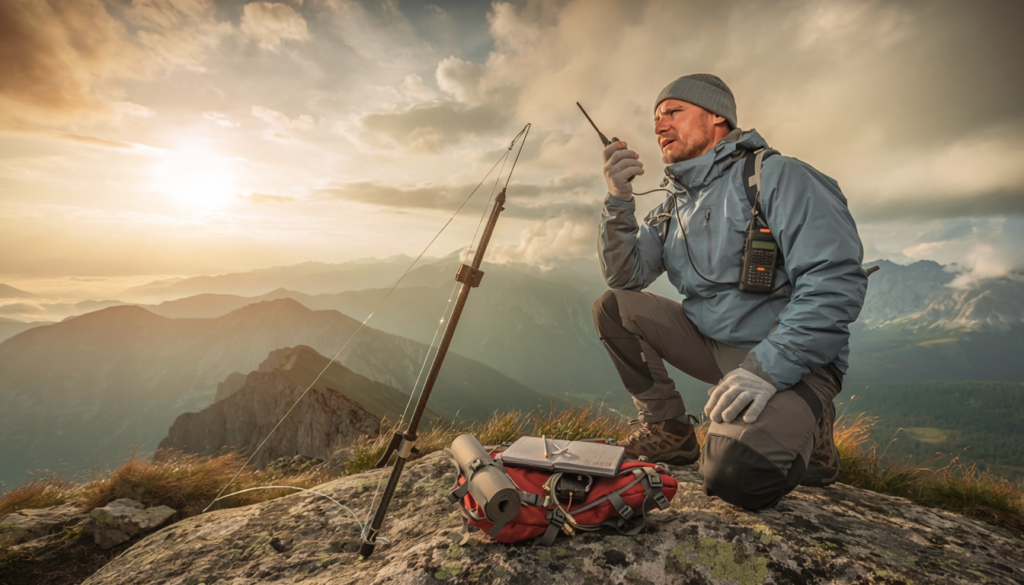
If you’ve been in ham radio for a while, you’ve probably heard the term SOTA tossed around in forums, in podcasts, or at club meetings. Maybe you’ve seen people post about climbing a mountain, setting up their radio gear and completing a SOTA activation from the top. And maybe you thought to yourself: that sounds incredible, but I have no idea where to start. That’s what this guide is for.
SOTA — Summits on the Air — is one of the most rewarding amateur radio activities you can get involved in. It combines outdoor adventure, portable operating, and the challenge of making contacts from difficult locations. Whether you’re a brand new Technician license holder or a seasoned ham looking for a new way to enjoy the hobby, SOTA has something to offer. Here’s everything you need to know to get started.
What Is SOTA?
SOTA stands for Summits on the Air. It’s an amateur radio award program that encourages hams to operate from mountaintops, hills, and other elevated natural locations. The idea is simple: you go to a qualified summit, you make contacts on the air, and you earn points based on those contacts.
The program was founded in the United Kingdom in 2002 and has since grown into a global activity with over 100 associations covering most of the inhabited world. There are currently around 100,000 registered summit locations across these associations. If there’s a meaningful peak in your area, there’s probably a SOTA summit nearby.
What makes SOTA different from a regular radio outing is the structured award system. It works just like POTA (Parks on the Air). Your contacts are validated, your points are recorded, and you can earn certificates and awards as you accumulate activations and contacts.
The Two Roles: Activators and Chasers
SOTA operates around two main roles.
An activator is a ham who physically travels to a summit and activates it by making amateur radio contacts. To count as a valid activation, you typically need to make a minimum number of contacts — four is the standard — and those contacts need to be confirmed through the SOTA logging system.
A chaser is any ham who contacts an activator during a SOTA activation. Chasers earn points, too — every valid contact with an activator earns the chaser points. If you’re not ready to haul gear up a mountain yet, you can participate as a chaser from your home station or mobile setup and still earn awards.
Most people start as chasers and work their way toward becoming activators. There’s no rule against it — the program is designed to reward participation at every level.
How the Points System Works
SOTA summit locations are assigned a point value based on their difficulty level. The higher and more remote the summit, the more points it’s worth. An easy summit you can drive to the top of might be worth only one point, whereas an activation from the top of Denali in Alaska is worth ten points.
Each summit has a unique identifier called an activation reference — something like W7/CM-001 or VK3/VE-001 — that ties it to the association’s database. When you activate that summit and make contacts, those contacts get logged and your score is calculated.
The points breakdown is straightforward:
- Activators earn points equal to the summit’s reference value for each valid contact
- Chasers earn points for each confirmed contact with an activator
- S2S contacts — where an activator contacts another activator on a summit — earn both stations the summit’s activation points
Points accumulate over time. There are no mandatory expirations — your lifetime SOTA score just grows as you operate. This makes it different from some other award programs that reset annually.
Associations and Geographic Structure
SOTA is organized geographically through associations. Each association corresponds to a country or region, and they’re managed by local volunteer coordinators who maintain the summit database and validate activations.
For hams in the United States, the main associations are:
- W7 — Pacific Northwest (Washington, Oregon, Idaho)
- W6 — California and Nevada
- W5 — Southwestern states (Arizona, New Mexico, Texas, Oklahoma)
- W4 — Southeastern states (Tennessee, Georgia, Carolinas, Florida)
- W8 — Great Lakes region (Michigan, Ohio, Indiana, Kentucky)
- W9 — Upper Midwest (Wisconsin, Illinois, Iowa, Missouri)
- W0 — Central plains states (North Dakota, South Dakota, Nebraska, Kansas)
Each of these associations has their own set of summit references, point values, and local rules. The association boundaries follow geographic regions rather than state lines exactly, so it’s worth checking the SOTA database for your specific area.
Canada has several associations (VE1 through VE7) covering different provinces. The UK has its own association (G) which is where the program originated. Most European countries have SOTA associations. Japan, Australia, New Zealand, and South Africa all participate. If you’re traveling internationally and want to activate, you just register with that country’s association.
What You Need to Get Started
Since you’re typically carrying your entire rig up a mountain on your back, you do need a bit of specialized equipment to get started. Most activators carry an HF rig because those bands have the activity and range to give you enough SOTA contacts to complete the activation. VHF-only activations do happen, but they’re the exception — typically limited to highly populated areas with lots of repeaters and other hams nearby. For most summits, an HF activation is the standard.
For Activators
The minimum you need to activate a summit is:
- An HF transceiver — The Xiegu G90, Yaesu FT-891 and Icom IC-705 are popular choices in the SOTA community. They all put out 25 watts or less, run off 12V battery power, and are small enough to carry in a backpack.
- A portable antenna — End-fed half-wave antennas are the standard for SOTA activations. The PackTenna and the various offerings by Par EndFedzare two commonly seen options in the field — both pack down small, set up in under ten minutes, and cover multiple HF bands without separate antennas for each band.
- A 12V battery — If your radio doesn’t have a battery built-in, LiPo packs designed for amateur radio use are the standard. A lithium battery like a Bioenno BLF-1215A doesn’t weigh much and will run a G90 or FT-891 for several hours without issue.
- A logbook — You’ll need to record each contact: callsign, frequency, time, and signal report. The official SOTA logging system is available at sota.org.uk, and several third-party apps and logbook programs support SOTA format directly. Use an app on your mobile device, bring a small laptop with you, or log manually with pen and paper.
- Hiking gear — A good hiking setup matters. You’re carrying radio gear up a mountain, so a solid backpack, proper footwear, and weather-appropriate clothing are just as important as the electronics.
For Chasers
If you’re starting as a chaser, you need:
- A functioning HF radio station — What matters is that you’re capable of making contacts on the bands activators are using, so some kind of HF radio rig is what you will need to get the most success.
- Awareness of when and where activations are happening — The SOTA database and spotting pages show real-time summit activations. You can watch for activations in your area or on bands you can work.
The SOTA Database and Logging
The SOTA program is built around its database at sota.org.uk. This is where you’ll find:
- The complete list of summit references and their point values
- Association rules and boundary maps
- Activation logs and leaderboards
- Award tracking and certificate requests
When you complete an activation, you log your contacts through the SOTA database system. Contacts are validated either through reverse-lookups (the database checks your log against the other station’s log) or through the chaser’s confirmation. This validation process is what makes SOTA awards credible — every point in your score has a verified contact behind it.
Several logging programs support SOTA directly, including Ham Radio Deluxe, Logger32, and a number of mobile apps. If you’re using a general logging program, you can export your SOTA contacts in the standard format required by the database.
Bands and Frequencies
SOTA activations happen across many of the same bands you’d use in normal amateur radio operation. The most common bands for SOTA are:
- 20 meters (14 MHz) — The most popular HF band for SOTA activations. It has good propagation during the day and supports long-distance contacts.
- 40 meters (7 MHz) — Popular for HF activations, especially in the afternoon and evening.
- 2 meters (144 MHz) — The most popular band for VHF activators in Europe. Repeater and simplex contacts happen here regularly.
- 70 centimeters (430 MHz) — Used alongside 2 meters for local activations.
You’ll also find activity on 15 meters, 10 meters, and occasionally 80 meters and 6 meters. The band you use depends on the time of day, propagation conditions, and what the activator has available.
HF activations typically require a transceiver capable of at least 5–10 watts on the HF bands and a portable antenna system. Most summits with a city nearby are accessible with HT-level power on VHF/UHF.
Summit-to-Summit Contacts
One of the most rewarding aspects of SOTA is the summit-to-summit (S2S) contact. This is when two activators on different summits make contact with each other. Both stations earn points equal to the activation reference of the summit they’re on — which means S2S contacts are a significant scoring opportunity.
S2S contacts also create a sense of community among activators. You’re not just making random contacts — you’re having a conversation with another ham who is on a mountain, doing the same thing you are, often in completely different terrain or weather conditions.
To make S2S contacts, you need to be alert to other activators spotted on the SOTA database or spotting network. When you see an activator in your region or on a band you can work, it’s worth calling them. The S2S contacts are often the highlight of an activation.
Getting Your First Activation
Start small. Don’t plan your first activation on a remote 8-point summit requiring a 12-mile hike. Pick a local summit that’s accessible by a trail or a reasonable forest road — something in the 1–2 point range that you can reach with basic hiking fitness.
Check the weather. This sounds obvious but it’s easy to skip when you’re excited about your first activation. Cold, rain, and wind all make operating harder, less enjoyable and even dangerous. A clear, calm day will give you a much better first experience.
Test your gear at home first. Make sure your antenna works, your batteries are charged, and you know how to log contacts properly. The last thing you want is to reach the summit and discover your radio won’t key up or your logging app is broken.
Announce your activation on the SOTA spotting network. When you log in to the SOTA database before your activation, you can post your presence to the spotting network. This tells other hams — especially chasers — that you’re on the air. More spotters means more contact opportunities, and a more successful first activation.
Pro tip – if you have some ham radio friends, coordinate with them ahead of time so they can be on the air when you summit and chase your activation. You only need four contacts to activate, and having one or two “in the bag” can minimize your wait time when you’re sitting there exposed on the peak.
The Bottom Line
SOTA is ham radio at its best. It gets you outside, it challenges you both physically and technically, and it connects you with a global community of operators who share your enthusiasm for making radio contacts from interesting places.
You don’t need expensive gear to start. A working HT, a better antenna than the stock rubber duck, and a willingness to get out there is enough for a 2m or 70cm activation if the summit is near a city with repeaters. Your first activation might be a hill near your house. That’s fine. That’s how everyone starts.
The beauty of SOTA is that it scales with you. Keep doing it, keep learning, keep building your skills, and eventually you’ll be making HF contacts from remote summits with operators on the other side of the world. The progression is real, it’s documented, and it’s earned.
Frequently Asked Questions
Do I need a special license to participate in SOTA?
What’s the difference between SOTA and POTA?
How do I find summits near me?
What happens if I can’t make the minimum four contacts for a valid activation?
Can I use a Yagi or directional antenna for SOTA?
Is SOTA only for mountain hiking, or can I activate from other elevated locations?

Join thousands of new hams who are confidently getting on the air. This practical video series gives you clear solutions to the most common beginner challenges — 100% free with instant access.
Affiliate Disclaimer
Keep in mind that we may receive commissions when you click our links and make purchases. However, this does not impact our reviews and comparisons. We try our best to keep things fair and balanced, in order to help you make the best choice.
As an Amazon Associate, we earn from qualifying purchases.