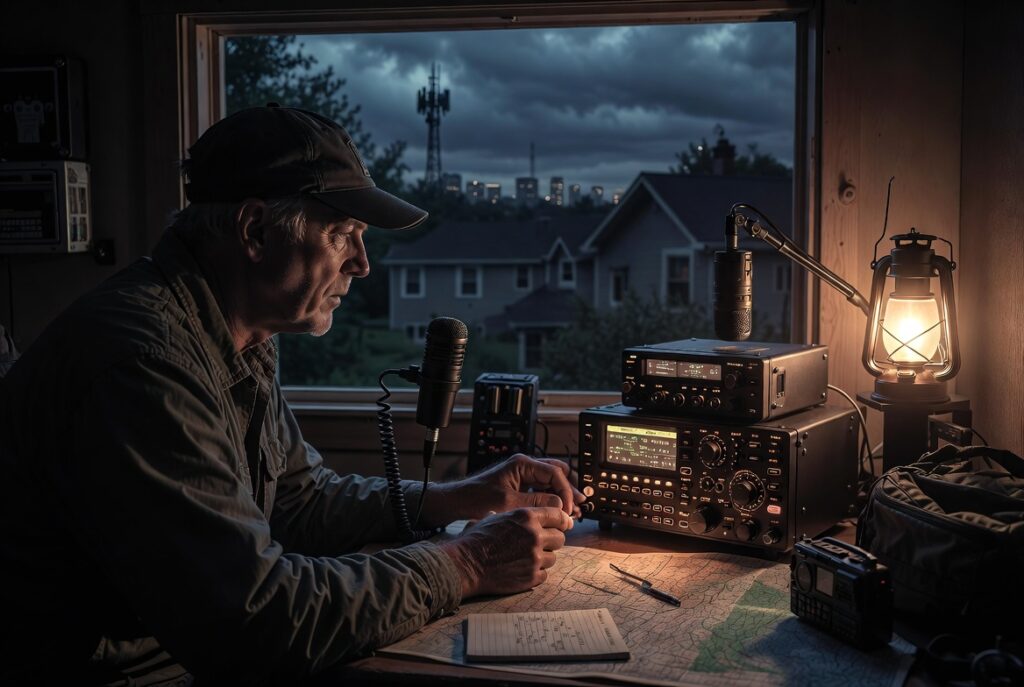
If the grid goes down, the cell towers go dark. Internet routers stop routing. Even the landlines quit if the power’s out at the central office. That leaves you with a problem: how do you talk to your family, your neighbors, or anyone outside your immediate circle when none of the normal ways work?
There are options that don’t depend on the infrastructure that surrounds you. And for anything beyond the most basic local communication, one of those options is a ham radio license.
Why Ham Radio Is the Real Emergency Communication Tool
Most communications systems are built on layers of dependencies. Your cell phone needs a tower. The tower needs power and a fiber back-haul. The fiber needs hardware that sits in buildings with their own power and cooling. Take out any one of those layers and the whole chain breaks.
Ham radio strips that chain down to almost nothing. A radio, an antenna, and a power source. That’s it. Two hams can talk to each other across the neighborhood or across the world without any intermediate infrastructure that might fail. This is why emergency management agencies at every level — FEMA, state EM teams, county coordinators — all maintain ham radio operators as part of their response plans. When the standard systems fail, ham radio is the thing that still works.
A Technician-class ham license — requiring a 35-question multiple choice exam — gets you on 2 meters and 70 centimeters, which are the backbone of local and regional emergency communication in most of the country. Here’s what that actually gives you:
The local repeater network. Across the United States there are tens of thousands of VHF and UHF repeaters, many of them maintained by local ham clubs and open for anyone to use. A repeater takes your signal, amplifies it, and rebroadcasts it. That extends your effective range from the few miles a handheld might reach on simplex to 20, 30, sometimes 50 miles or more depending on the repeater location and terrain. In most populated areas, you’re within range of at least one repeater. In many areas, you’re within range of several.
This means a handheld ham radio connected to the local repeater system can reach people across an entire county. That’s not a theoretical number — that’s how it works right now, for anyone with a license and a radio. A solid prepper-level handheld like the Yaesu FT-60R runs around $170 and is built well enough to be the radio you actually trust when it matters, plus it can run on AA batteries with the right adapter. If you’re on a tight budget, even a $16 Baofeng UV-5R is enough to get you connected locally.
ARES: the organized volunteer network. ARES stands for Amateur Radio Emergency Service. It’s a nationwide volunteer organization of licensed hams who’ve registered with their local emergency management agencies to provide communication support during disasters. When something big happens — a hurricane, a flood, a tornado outbreak — ARES operators are activated to handle communication because they’re the thing that still works when everything else is down.
Joining ARES is free. It requires a valid ham license and completing a short registration with your local ARES emergency coordinator. In exchange, you get training, you get to practice with experienced operators, and you become part of an actual response network. More importantly, you become someone who can call on that network when you need it.
The point here isn’t just good citizenship. Being part of ARES means you’re practicing with the same people you’ll be working with during an actual emergency. You know who they are, they know you, and you’ve already worked out the communication protocols together. That relationships-before-the-emergency thing is one of the most underrated aspects of being a prepared ham operator.
Public service nets. Most communities have weekly or monthly nets run by local ham clubs on local repeaters. These are practice sessions — the operators check in, run through communication protocols, and test their equipment. They’re also open to anyone with a license. Checking into your local nets regularly is one of the simplest and most valuable things you can do to stay prepared.
A much more robust set of tools. On the ham frequencies you’ve got access to much higher power than FRS or GMRS, better antennas, digital modes that can push text through marginal band conditions, and the entire infrastructure of the amateur radio community. If you’re serious about emergency communication at the local and regional level, ham radio gives you capabilities that FRS and GMRSsimply can’t match.
FRS and GMRS: For Unlicensed Family and Friends
FRS and GMRS do have their place. They’re tools you can use to stay in touch with family members and neighbors who don’t have a ham license. If your spouse, your kids, or your neighbors aren’t licensed hams, FRS and GMRS radios let them communicate with you and with each other without having to study for an exam.
FRS is the simplest option and requires no license at all. These are the bubble-pack radios you see at Walmart. They’re limited to 2 watts on most channels (and half a watt on a handful of others), which means their range is honestly maybe a mile or two in open terrain, less in wooded areas or neighborhoods with lots of buildings. For immediate household or neighborhood communication where no license is needed, FRS works.
GMRS shares frequencies with FRS but allows significantly higher power. A GMRS handheld can run up to 5 watts, and a mobile or base unit can go all the way to 50 watts — and GMRS can use repeaters, which FRS can’t. That translates to noticeably better range, especially in suburban and rural environments. You can typically get 5 to 10 miles from a GMRS handheld in reasonable conditions, and a 50-watt mobile into a GMRS repeater can cover a lot more ground than that.
Here’s the honest comparison, though: even at 50 watts with a repeater, GMRS is still a closed system. There’s no ARES, no HF, no digital infrastructure, no nationwide network of operators trained to work together when things fall apart. GMRS gives you range. Ham radio gives you range plus everything else. That’s the difference that matters when the stakes are real.
GMRS requires a license, but there’s no exam. You pay a one-time $35 filing fee with the FCC and that license is good for ten years. One license covers you and your immediate family members. Most GMRS radios also support FRS channels, so a dual-format radio lets you talk to licensed family members on GMRS and anyone on FRS without switching devices. A dual-format GMRS handheld in every household member’s hands is the simplest way to bring the non-hams in your group onto a common system.
The recommendation: get your GMRS license, put dual-format radios in every household member’s hands, and use FRS and GMRS as the bridge to people who aren’t hams. Your ham license and your access to the repeater network and ARES is the backbone of your actual emergency communication capability. FRS and GMRS can handle the people who can’t or won’t get licensed.
Keeping the Power On
All of these radios are useless without power, and this is where most people underestimate the planning required. A mobile system installed in your car will keep running as long as your vehicle does. A handheld radio requires some additional planning to stay operational if the grid goes down.
Start with understanding your radio power consumption. A handheld radio transmitting at 5 watts draws somewhere around 1.5 to 2 amps at full power. Most handhelds have battery packs that’ll run for 8 to 12 hours under normal use, but during an emergency with lots of transmissions, that drops significantly.
For short situations, spare batteries kept charged will cover it. For longer events, you need a 12-volt power option. A quality 12-volt battery — like a LiFePO4 lithium battery — will run your handheld radio for dozens of hours. You can charge it from your car, a solar panel, or a generator.
Keep spare batteries for your handhelds, keep a 12-volt battery for extended operation, and have a way to charge from your car or a solar panel. In a grid-down scenario that lasts more than a few hours, that battery’s the difference between being able to communicate and being cut off.
Getting Your License
The Technician class exam covers the basics — electronics, operating practices, FCC regulations, a little bit of propagation science. Most people study for a few weeks using free online resources and pass it.
The question pools are public. There are free practice tests online. The total cost to get licensed is under $50 in most cases. The exam’s administered by volunteer examiners at local ham clubs, and you can usually schedule one within a week of deciding to take it.
Hamstudy.org is the best free resource. It’s got every current exam question, tracks your progress as you study, and tells you when you’re ready to take the real test. A few weeks of consistent study is all most people need.
Practice Before You Need It
Buy the radio. Program the channels. Then actually use it. Listen to traffic on local ham repeaters. Check into your local public service net. Test your handheld around the neighborhood so you know what the actual range is, not what the marketing says it is. Run through a communication plan with your family — who says what, how do you confirm a message was received, what do you do if the channel’s busy?
In a real emergency, you won’t have time to figure this out from scratch. You’ll be stressed, things will be happening fast, and the last thing you need is to be trying to figure out how to use your radio for the first time.
Test your setup regularly. Know what works, what doesn’t, and what you need to fix before you need it.
Going Further: HF for National and Global Communication
If you want to reach beyond your region — to get national or international news, emergency information, or contacts across the country when local infrastructure’s completely down — HF (high frequency) amateur radio is the tool that makes that possible.
HF works differently than VHF and UHF. The signals bounce off the ionosphere and can travel thousands of miles with relatively modest power. During a major disaster that takes out local and regional communication infrastructure, HF radio operators can still reach across the country and around the world. This isn’t theoretical — it’s how it works every time there’s a hurricane, wildfire, or flood that takes out normal communications.
Using HF requires more. A dedicated HF rig is significantly more expensive than a handheld — you’re looking at $500 to over $1,000 for something that’ll do the job properly. You need multiple antennas for different band conditions. And to get beyond a few basic privileges, you need a General class license or higher, which requires passing an additional exam with more technical content.
For most people focused on local and regional emergency communication, your Technician license and the VHF/UHF repeater network will cover what you need. HF’s there for people who want to go further — who want the option to receive nation-wide emergency information, make contacts across the country, or participate in the long-distance emergency networks that support actual disaster response. If that describes your goals, start with your Technician license, get comfortable on VHF and UHF, and plan to add General class and HF capability as a second phase.
The Independent Variable
What makes ham radio uniquely valuable for preppers isn’t any single feature. It’s that it operates independently of every other system. The power grid, the internet, the phone network, the cellular network — none of them are required. You can communicate using batteries, solar panels, or a car battery, and reach people across your neighborhood or around the world depending on which tool you’re using.
That independence is the whole point of preparedness. You build capabilities that work when the normal systems don’t. A Technician-class ham license puts you on the local repeater network, gives you access to ARES, and gives you a set of communication tools that are far more robust than anything that requires a license to use. FRS and GMRS fill the gap for family members who aren’t licensed. HF’s there for when you want national and global reach.
These are practical, tested, available tools that have been keeping people connected through every kind of disaster for over a century. Getting your ham license and building a simple station is one of the highest-leverage steps you can take toward genuine emergency preparedness. It’s not complicated. It’s not expensive. And here’s the thing about all of it: the time to get licensed, programmed, and practiced is before you need it — not in the middle of the emergency when it’s already too late. Get started now, and you’ll be glad it’s there.
Join thousands of new hams who are confidently getting on the air. This practical video series gives you clear solutions to the most common beginner challenges — 100% free with instant access.
Affiliate Disclaimer
Keep in mind that we may receive commissions when you click our links and make purchases. However, this does not impact our reviews and comparisons. We try our best to keep things fair and balanced, in order to help you make the best choice.
As an Amazon Associate, we earn from qualifying purchases.