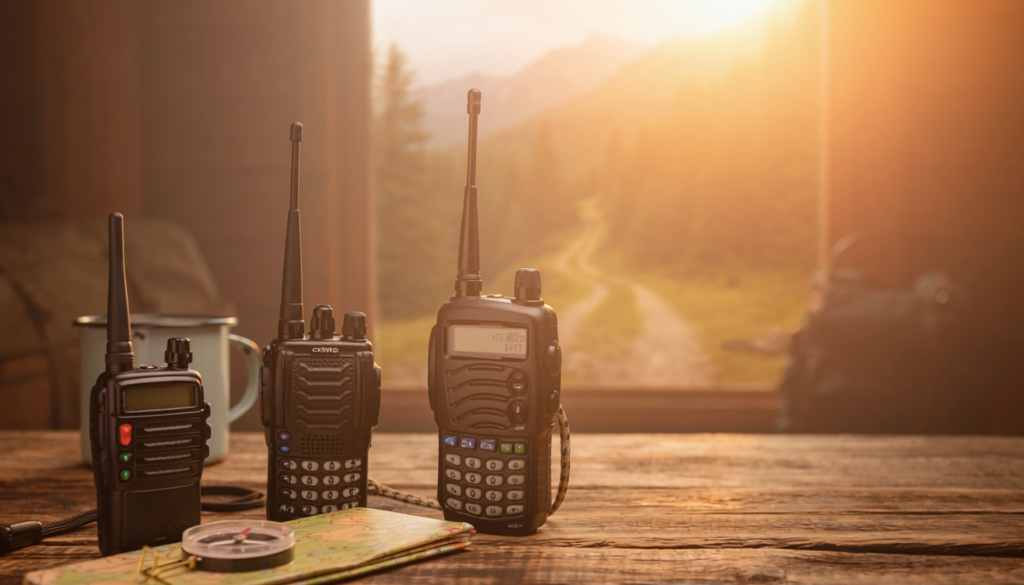
If you’ve been looking into walkie-talkies or personal radios, you’ve probably run into three terms that sound like they mean the same thing: FRS, GMRS, and Ham Radio. They’re not the same. And the difference matters.
Here’s the short version: FRS is license-free, and GMRS requires a license, but no exam. They are both consumer-grade options. Ham Radio requires an exam and gives you capabilities that FRS and GMRS can’t touch. Which one you actually need depends on what you’re trying to do.
Let’s break it down.
What Is FRS?
FRS stands for Family Radio Service. It’s a set of frequencies the FCC designated for short-range, license-free personal communication. You can buy an FRS radio at any sporting goods store and start using it right out of the box — no test, no fee, no registration.
FRS radios are typically small, handheld, and low-power — usually a maximum of 2 watts on the high-power channels. They’re designed for short-range communication: hiking trails, camping, neighborhood use, keeping track of family at an event. Range varies wildly based on terrain and obstacles, but you’re usually looking at a few miles at best in real-world conditions.
Good for: Casual family communication, outdoor recreation where you don’t need serious range, beginners who just want something that works.
Not so good for: Long-range communication, reliable emergency backup, anyone who needs to talk beyond a few miles.
What Is GMRS?
GMRS stands for General Mobile Radio Service. It’s related to FRS — they share some channels — but GMRS allows higher power (up to 50 watts on mobile units) and requires an FCC license. The license is cheap ($35 for 10 years) and has no test — you just get a free FRN number, fill out a form and pay. The nice thing is that one license covers your whole family.
GMRS gives you significantly more range than FRS, especially when used with a better antenna or a mobile unit in a vehicle. Many “FRS/GMRS” radios on the market can use both services — FRS channels are license-free, but you need a GMRS license to transmit on the higher-power GMRS-specific channels.
The key thing people miss: your FRS license-free status only covers the FRS channels at FRS power limits. If you buy a dual-mode radio and crank up the power on a GMRS channel, you need that license.
Good for: People who need more range than FRS offers, preppers who want something more capable without studying for a test, families who want reliable communication over larger areas.
Not so good for: Access to advanced features, interoperability with other services, serious emergency communications infrastructure.
What Is Ham Radio?
Ham Radio — also called Amateur Radio — is an entirely different level. It requires passing one or more written exams (Technician class is the entry level) to get your license. The exam covers regulations, basic electronics, and operating practices. It’s not hard, but it does require studying.
What do you get for that effort? Access to vastly more frequencies, much higher power (up to 1,500 watts on some bands), and capabilities that FRS and GMRS can’t approach:
- Thousands of channels across HF, VHF, and UHF bands
- Worldwide communication — HF radio can bounce signals around the planet
- Digital modes — APRS, packet radio, FT8, DMR, and more
- Local repeater networks that can extend your range across entire regions
- Emergency communications infrastructure that outlasts cell networks
Ham radio operators build their own equipment, participate in contests, talk to astronauts on the International Space Station, and provide critical communications during disasters when nothing else is working.
Good for: Serious emergency preparedness, hobbyists who want to explore radio as a skill, anyone who needs reliable long-range or global communication capability.
Not so good for: Casual users who just want to talk to their kids across the neighborhood.
The Comparison Table
| FRS | GMRS | Ham Radio | |
|---|---|---|---|
| License Required | No | Yes ($35/10yr, no test) | Yes ($50/10yr, test required) |
| Max Power | 2 watts | 50 watts (mobile) | 1,500 watts |
| Range | A few miles | 5–25+ miles | Local to worldwide |
| Channels | 22 (shared with GMRS) | 30+ channels | Thousands across bands |
| Equipment Cost | $20–$100 | $30–$300 | $30–$2,000+ |
| Digital Modes | No | No | Yes (many) |
| Global Communication | No | No | Yes (HF bands) |
So Which Do You Actually Need?
Get FRS if: You just need something for casual use. Kids walking around a campground, communication at a festival, keeping track of family in a neighborhood. Cheap, simple, no hassle.
Get GMRS if: You need more range and reliability than FRS offers, you’re serious about emergency preparedness but don’t want to study for a test, or you’re willing to spend a little more for better equipment.
Get Ham Radio if: You want the full capabilities of radio communication, you’re interested in the hobby side (DXing, awards, digital modes), you need emergency communication that can operate when infrastructure fails, and you’re willing to put in the study time to earn your license.
Can You Use a Baofeng for FRS/GMRS?
Short answer: Kind of, but be careful. Baofeng radios are popular because they’re cheap and can transmit on FRS/GMRS frequencies. However, some Baofeng models can also transmit on frequencies they’re not licensed to use — including Ham Radio bands. Using a Baofeng on the wrong frequencies or power levels can get you in trouble with the FCC.
If you buy a Baofeng, learn what you’re legally allowed to do with it. Technically the Baofeng UV-5R is classified as an “amateur radio” with the FCC, and is not legal to use for transmitting on the GMRS frequencies. Stick to GMRS listening only to remain compliant.
The Bottom Line
FRS, GMRS, and Ham Radio are three different tools for three different jobs. Most people start with FRS and upgrade as their needs grow. If you’re at all serious about emergency communication or interested in what radio can really do, the Ham Radio license is worth the effort — and the entry-level exam is easier than most people expect.
Join thousands of new hams who are confidently getting on the air. This practical video series gives you clear solutions to the most common beginner challenges — 100% free with instant access.
Affiliate Disclaimer
Keep in mind that we may receive commissions when you click our links and make purchases. However, this does not impact our reviews and comparisons. We try our best to keep things fair and balanced, in order to help you make the best choice.
As an Amazon Associate, we earn from qualifying purchases.