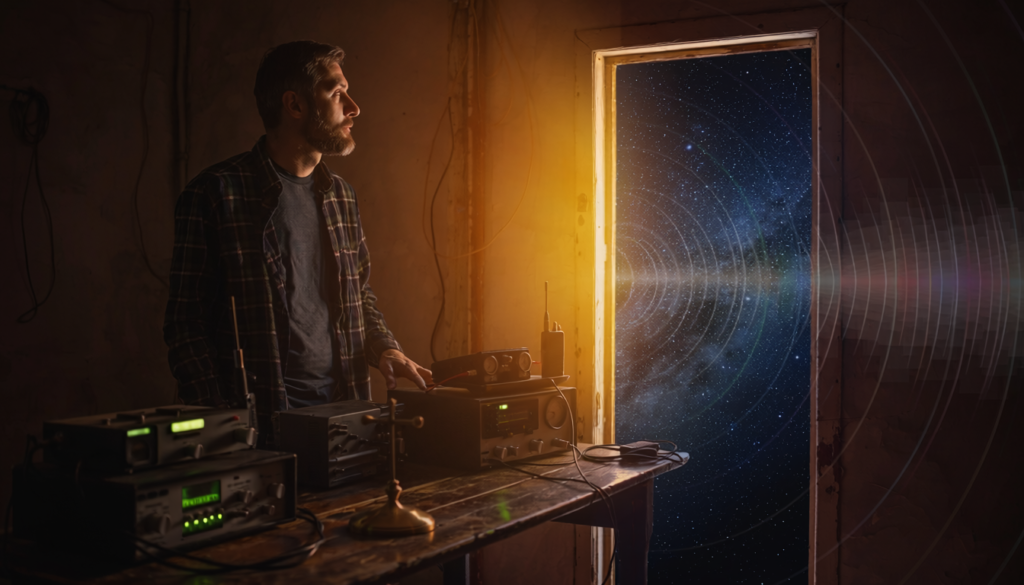
You passed your Technician exam. You got your license in hand. Maybe you’ve been chatting on local repeaters, experimenting with your first handheld, maybe even checked into a net or two. And it’s been great. But if we’re being honest — there’s a whole world of ham radio you’ve been peeking at through the window, unable to open the door.
That door is the General class license. And when you walk through it, everything changes.
What’s Actually Different About General Class Ham Radio?
Let’s be specific about what opens up. As a Technician, you have access to:
- All VHF and UHF bands (2 meters, 6 meters, 70 centimeters, and more)
- Some very limited HF privileges— you can only talk on a small slice of 10 meters with lower wattage
- CW (Morse code) privileges on some other HF bands – but not voice!
That’s great. That’s mostly local. That’s useful. But here’s what’s waiting on the other side of General:
- Full access to almost all the HF bands — 160m, 80m, 40m, 20m, 15m, 10m
- The ability to run up to 1,500 watts of power on the HF frequencies
- The modes that make long-distance contacts possible — SSB voice, CW, digital modes like FT-8
- Access to the bands where DX happens — where you’re talking to Japan, Germany, Brazil, Australia
That’s not just more privileges. That’s a completely different hobby.
The HF Bands: Where the Magic Happens
If Technician is the neighborhood, General is the whole world.
HF (High Frequency) is what makes worldwide contacts possible. With Technician, you’re mostly limited to VHF/UHF — line-of-sight range, local contacts, regional traffic. With General, you can reach thousands of miles away on 20 meters during daytime, 40 meters in the evening, 80 meters at night. 15 meters, 10 meters, even 160 meters when conditions are right.
Think about that. You’re sitting in your shack in Texas, and you’re talking to someone in Japan. Or Finland. Or South Africa. On a radio you own. For free. No cell towers, no internet, no infrastructure — just you, your antenna, and the ionosphere doing its thing.
That’s not a niche interest. That’s not outdated technology. That’s the magic that keeps drawing people into ham radio, and it’s almost entirely locked behind the General class license.
Technician vs. General: What You’re Missing
Here’s the honest breakdown of what Technician doesn’t have that General does:
- HF voice privileges on the major HF bands — No 20m, no 40m, no 15m. These are the most popular bands in ham radio, and Technician can’t touch them.
- DX contacts — Without HF access, “working DX” means very limited 10m contacts, maybe VHF scatter or a rare satellite pass. With General, you can chase DX on any given day. There’s almost always someone active somewhere in the world on one of the HF bands.
- Contest participation at the full level — Contests like Field Day, DXCC, CQWW, and others primarily happen on HF bands. General class operators can play the whole game.
- POTA and SOTA on HF — Parks on the Air and Summits on the Airactivations are only really worthwhile on HF. The best activations — the ones with dozens of contacts from all over — happen on General class frequencies.
- More power options — Higher wattage makes a real difference when you’re working weak signals across the world.
Why Hams Who Skip General Regret It
I’ve talked to a lot of hams over the years. And you know what one of the most common regrets is? “I waited too long to get my General.”
Some operators stayed on Technician for years — maybe decades — telling themselves they’d get around to it. That HF was too complicated. That the equipment was too expensive. That they were fine with what they had. And eventually, almost all of them wished they’d just done it. I know, because I’m one of them!
When I got my Technician license back in 2010, that was all I really knew about or understood. General seemed overwhelming and complicated. When I handed in my Technician exam, the examiner asked if I wanted to take General while I was there. No risk and no extra cost. I declined, and didn’t end up getting General until a decade later. I missed out on 10 years of the best stuff ham radio has to offer.
Here’s the thing: General isn’t that much harder. The new skills needed to operate on HF bands are not difficult to learn…especially if you have an experienced Elmer to show you the ropes.
The hard part — the studying — is the same barrier for Technician and General. You already know how to pass a ham radio exam. You already know the basic material. General goes deeper on the same topics, with HF information added in: more electronics, more RF concepts, more rules, but totally doable.
Studying Smarter: Technician and General Together
Here’s something most people don’t realize: the Technician exam is the foundation for General. The questions overlap significantly — about 60% of General class material is already covered at least partially in Technician. When you study for both exams at the same time, you’re not doing double work. You’re building on what you already learned.
Even better: you can take both exams in a single exam session. Same format (35 questions, 74% to pass), same $15 fee (per exam), same VEC volunteer examiners. Walk in prepared, leave with both licenses.
The video courses at Ham Radio Prep are an excellent study resource to help you do this. Check out their Technician + General bundle (use coupon code HRLaunchpad to save 10%). It walks you through preparing for both exams together, focusing on the essentials needed to pass both in one sitting — efficient, streamlined, and designed for people who don’t want to wait years to unlock the HF bands.

What’s Waiting on the Other Side
Once you have your General class license, here’s what’s actually possible:
Your first DX contact. Working a station in Japan or Europe for the first time is one of those experiences that doesn’t get old. The first time you hear “73s from 7J1ATX” and realize you’re actually talking around the world — that moment is real. It happens to every new General class operator, and it’s always exciting.
Your first POTA activation on HF. Setting up in a state park, calling CQ, and working dozens of hunters from your portable station is one of ham radio’s great experiences. On HF, the variety of contacts is incredible — you’ll work people from across the country and around the world in a single afternoon.
Your first contest. Field Day is the big one — thousands of hams set up emergency-style stations and make as many contacts as possible over 24 hours. As a General class operator, you’re in the game on all bands. It’s chaotic, energizing, and a fantastic way to build skills fast.
Ragchewing on the HF bands. Not everything is quick contacts. Some of the best conversations in ham radio happen on 40 or 80 meters in the evening — long, relaxed ragchews with operators from across the country and beyond. This is where ham radio becomes a community, not just a hobby.
Don’t Wait — Go Get Your General
Here’s my honest advice: don’t leave Technician as your permanent home. It’s a great starting point. It’s the right first step. But it’s just that — a starting point.
General class ham radio opens up everything that makes this hobby remarkable. The HF bands, the DX, the contests, the POTA activations, the long-distance ragchews — all of it is waiting for you once you have that license.
And the studying isn’t as hard as you might think. You already know the foundation. You already passed one exam. The General exam is the same game, deeper rules, and a moderate amount of additional content. A few weeks of focused study, and you’re there.
Go get it. The bands are waiting.
Ready to unlock the HF bands? Ham Radio Prep’s Technician + General video training course bundle walks you through everything you need to pass both exams on the same day and get on the air with full privileges. Use coupon code HRLaunchpad to save 10%.
Join thousands of new hams who are confidently getting on the air. This practical video series gives you clear solutions to the most common beginner challenges — 100% free with instant access.
Affiliate Disclaimer
Keep in mind that we may receive commissions when you click our links and make purchases. However, this does not impact our reviews and comparisons. We try our best to keep things fair and balanced, in order to help you make the best choice.
As an Amazon Associate, we earn from qualifying purchases.