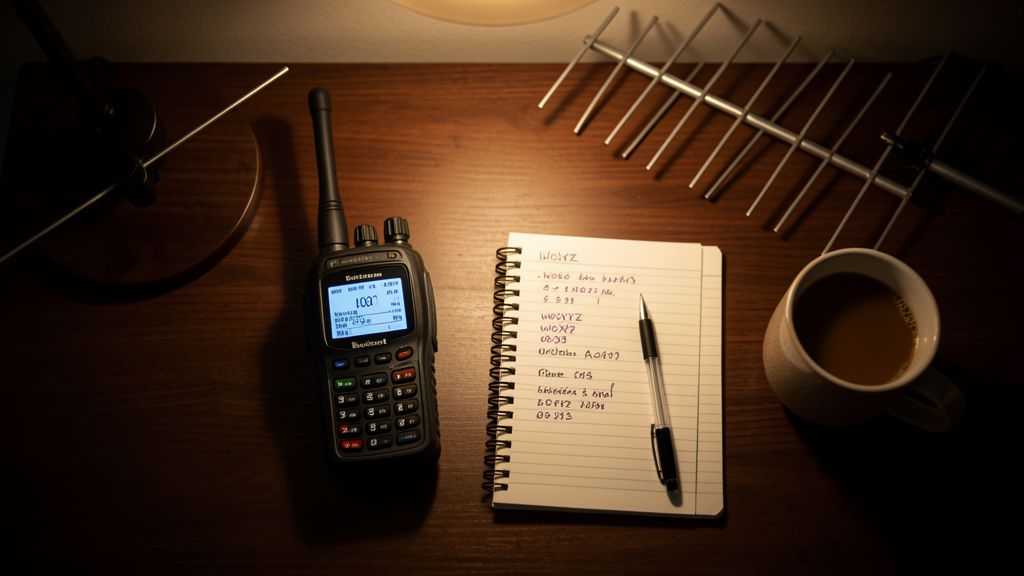
You passed. Your call sign is in the FCC database. You have your Technician-class license and you have no idea what to do next. This is the 30-day plan — the four weeks that turn a piece of paper into a hobby, and that put you on the path to your General license before the test-taking muscle memory fades.
The first month is about three things. Get comfortable on the air (and get past the mic fright). Build the habit of listening and transmitting. Avoid the common mistakes that burn new hams out before they ever make a real contact. The rest of this article is the plan. If you want a more hand-holding walk-through first, my free Top 5 Beginner Ham Radio Frustrations video series covers the most common early stumbles in 30 minutes — start there if you’d like some company on the way in.
Some new hams never get on the air. The license is your ticket to the airwaves. The first 30 days are what determine whether it becomes a hobby or stays a piece of paper.
Days 1–3: The first moves
The goal of the first three days is simple: get on the air once. Not “understand HF.” Not “learn how to build your own antenna.” Just make one contact.
Day 1: Program your radio for your local repeaters. Use RepeaterBook.com (free) to find three to five repeaters within about 25 miles of you. Enter the frequencies, offsets, and PL tones. Don’t worry about memorizing any of it — keep the cheat sheet next to your radio.
Also on Day 1, pick one of those repeaters and monitor it passively for 20 minutes. Just listen. Note the call signs, the cadence, the patterns. This isn’t wasted time. It’s the fastest way to learn how hams actually talk to each other, and the way they actually talk is way more casual than the test makes you think.
Day 2: Listen to a local net if there is one. Most areas have daily or weekly nets on a specific repeater at a specific time. Just check in as a listener the first time. Check out how to join your first ham radio net to learn more.
Day 3: Make your first contact. The easiest path is to check in to a net (nets are designed to welcome newcomers), to just call out on a busy repeater with “monitoring,” or drop a directed call to a station you heard talking. Yes, your hands will shake. Everyone’s did.
The “do it poorly” principle
This is the most important thing to understand about the first 30 days. The point is not to sound polished, well-informed, or technically correct. The point is to push the PTT button while your hands are still shaking.
Mic fright is real, and the only cure is repetition. Every experienced operator on the other end of your first contact was once a new ham fumbling their call sign. They remember. They will be kind. Make the call. Stumble through it. Make another one tomorrow. Doing it badly ten times in your first week teaches you more than studying for ten more hours. The mic is the textbook.
The commute window
Most repeaters see the highest activity during morning and evening commute hours — roughly 7 to 9 AM and 4 to 6 PM on weekdays, when people are driving to and from work with their mobile radios in the car. If you can only get on the air once a day, time it for one of those windows. The repeater won’t be dead. You’ll have people to talk to.
Days 4–10: Build the habit
The goal of this window is to get on the air three to five more times. You are no longer “trying ham radio.” You are a ham. Act like one.
Make at least one contact every two to three days. It doesn’t have to be long. “W0XYZ, this is KD0ABC, just saying hello and testing. Back to you.” That’s a contact. You don’t need to fill ten minutes of airtime.
Radio checks are your friend
A radio check is the lowest-stakes way to get on the air. Key up, give your call sign, and say “This is (your call sign) doing a radio check.” Another ham monitoring the frequency will come back and tell you how your signal sounds — how readable you are, whether your audio is clean, how your signal sounds going into the repeater. It’s a 30-second exchange. It counts as a contact. It’s how hams who already know each other confirm their setups are still working, and it’s how new hams get on the air without needing a conversation topic. A radio check is a great ice-breaker, especially on days when you don’t have anything to say but want to get on the air. It’s also obviously useful when you’re breaking in new equipment.
Find your local ARRL Affiliated Club. Most areas have at least one. Show up to a meeting — in person if possible. New hams showing up is a reason most clubs exist. Clubs are also the lowest-friction way to find an Elmer (the ham radio term for a mentor) if you want one.
Listen more than you transmit (but keep transmitting). Listen to an HF frequency if you can. Listen to a public service net. Listen to a contest. Each mode of operation has its own rhythm, and you can’t learn it by reading.
Days 11–20: Try a new thing
The goal of this window is to expand your horizon. Pick one new mode or activity to try. Don’t try them all at once.
- A public service event. Many clubs run communications for marathons, parades, and bike rides. Showing up to help is the fastest way to learn operational discipline and meet active hams. In the summer, Field Day is a great experience…check out my ARRL Field Day beginner’s guide for more info.
- A digital mode or data activity. DMR (Digital Mobile Radio) is digital voice over a network of linked repeaters — it runs on an HT in the $150 range and gives you access to a much wider range of hams than your local repeater, including regional and nationwide talkgroups. APRS (Automatic Packet Reporting System) is position reporting, short messages, and telemetry sent from your radio to a network of digipeaters and internet gateways — popular with hikers, mobile operators, and public service events.
- A simplex contact. Try talking to another ham directly, without a repeater. Five to ten miles on 2 meters or 70 centimeters is achievable with a stock HT and a better antenna. This is the gateway to understanding antennas, gain, and the limits of your radio.
- A satellite. If you have a dual-band HT and a clear view of the sky, you can try working amateur radio satellites. Passes are short — usually under 15 minutes, and the workable part is shorter than that — since the satellite is moving across the sky the whole time. You can get into some satellites on a high pass with a stock or upgraded whip, but a handheld Yagi (a small directional antenna you point and track by hand) is what turns lucky contacts into reliable ones.
The point of this section is not to make you an expert. The point is to show you that ham radio is a multi-decade hobby with a deep bench of activities. Most new hams get bored because they only ever do one thing.
Days 21–30: Upgrade to General as fast as you can
You have a Technician license. You have 21 to 30 days of operating experience under your belt. The natural next move is to upgrade to General — and to do it as quickly as possible.
You just passed the Tech exam. The test-taking muscle memory is fresh. Studying for General while that habit is still warm is a lot easier than starting again cold in six months (or possibly never). Every month you delay is a month where the test material feels less familiar. And the upgrade unlocks a much bigger version of the hobby: HF access means worldwide communication with voice, CW, and digital modes. It opens up activities like POTA (Parks on the Air), SOTA (Summits on the Air), and DXing (chasing long-distance contacts with stations in other countries) — none of which are accessible to a Technician on a meaningful scale. A General license is what turns ham radio from a local-repeater hobby into a worldwide one.
The right study tool for the upgrade
Ready to upgrade to General? A good video course saves you study time and helps the concepts actually stick. That’s why I recommend Ham Radio Prep’s General course — video lessons paired with practice questions from the actual General pool, so you’re not just memorizing, you’re understanding.

Ham Radio Launchpad readers get 10% off: click here and use the code HRLaunchpad at checkout.
The actual 30-day goal
By day 30, you should be (1) active on the air regularly, (2) connected to your local ham community through a club, a net, or a public service activity, (3) exploring new areas of the hobby beyond local repeater chat, and (4) signed up and starting to study for your General exam. This will put you miles ahead of someone who gets licensed and doesn’t know what to do next.
Common first-month mistakes
A short list of the patterns that burn new hams out before they ever make a real contact. Read them. Avoid them. Move on.
Mistake 1: Buying gear before you know what you want to do with it
Decide what you want to do first. Then buy the gear that fits the needs of that activity. Every piece of equipment you buy should have a purpose tied to a specific activity you intend to do. A $600 HF rig is worthless if you haven’t figured out whether you want to do SSB phone, CW, or satellite work. A directional Yagi is worthless if you’ve never tried a satellite. A mobile rig is worthless if you don’t have a car. The new-ham reflex is to buy gear first and figure out the hobby second. Reverse it. The hobby comes first. The gear follows.
Mistake 2: Spending 90% of your time listening and 10% transmitting
Listening is a skill, and you should listen more than you talk, especially early on. But if the ratio is 90/10, you will never get comfortable on the air. Aim closer to a 50/50 split — listen enough to learn the patterns, then transmit often enough to build the habit. The mic is the textbook. Pushing the PTT button is studying.
Mistake 3: Not checking in to nets
Some new hams only lurk on the nets because they feel intimidated to key up. That instinct is wrong. Nets are the most beginner-friendly activity in ham radio. The net control station wants you to check in — that is literally what the net is for. You’ll learn call signs, signal reports, and how a directed conversation sounds. Worst case you make a slightly awkward first check-in.
Mistake 4: Comparing yourself to old hams
The Elmer who’s been doing this for 40 years and knows every band’s propagation by feel — you will not be that person in 30 days. You will not be that person in 3 years. The hobby is long. Everyone started exactly where you are.
Mistake 5: Treating the license as the goal
It’s not. The goal is operating. The license is the entry fee. If the test is your finish line, the next 30 days will feel boring. If the test is your starting gun, the next 30 days will feel like the beginning of a long, interesting run.
Where to go from here
After day 30, your direction depends on what you enjoyed:
- If you liked repeater operating → join a club, check in to nets weekly, get involved in a public service event.
- Start studying for your General license — seriously, start now while the test-taking habit is still fresh.
- If you liked the technical or building side → start with learning how to build your own antennas.
- If you liked emergency communications → look into ARES (Amateur Radio Emergency Service) or RACES (Radio Amateur Civil Emergency Service) in your area.
- If you want a free, no-commitment way to keep learning → my Top 5 Beginner Ham Radio Frustrations video series covers the most common early mistakes in 30 minutes.
Frequently asked questions
I just got my Technician license. When can I transmit?+
As soon as your call sign appears in the FCC ULS (Universal Licensing System) database. If your VE session used electronic filing through an ARRL VEC or W5YI VEC coordinator, your call sign can appear the same day or the next business day. If the session was filed by paper, it can take one to three weeks for the call sign to be issued. You can check the FCC ULS database at wireless2.fcc.gov.
Do I have to identify myself every time I transmit?+
Yes. Per FCC rule 47 CFR § 97.119(a), each amateur station must transmit its assigned call sign at the end of each communication and at least every 10 minutes during a communication. In practice, that means you identify at the end of every contact, and you re-identify every 10 minutes if the contact goes longer than that.
Can I use any frequency I want as a Technician?+
No. Technician-class privileges are limited. You have full access to all amateur frequencies above 30 MHz (VHF and UHF, where most repeater activity lives), plus limited access to small slices of the HF bands on 10 meters, 15 meters, 40 meters, and 80 meters, mostly on CW (Morse code) and digital modes. The full chart is in your license manual and on the ARRL band plan. The General license unlocks the rest of HF.
What if I make a mistake on the air?+
Nobody cares. Hams call it “keying the wrong way” or “going long.” It’s a non-event. The other operator will probably just smile (figuratively), help you out if you need it, and move on. The fastest way to get over mic fright is to make enough mistakes that you stop being afraid of them.
Do I need to log every contact?+
You don’t need to log every local VHF/UHF contact. Logging is most useful for HF contacts where confirming a QSO (a two-way contact) with a distant station matters — for award programs like DXCC, WAS, or contest scoring. Many hams keep a casual log anyway, but it’s not a beginner-on-repeaters requirement, and it isn’t enforced by the FCC for routine local VHF/UHF operating.
Get on the air today. Push the PTT button while your hands are shaking. Make a radio check tomorrow morning during the commute. Sign up for the General exam before the month is out. The first 30 days are what turn a license into a hobby.
Join thousands of new hams who are confidently getting on the air. This practical video series gives you clear solutions to the most common beginner challenges — 100% free with instant access.
Affiliate Disclaimer
Keep in mind that we may receive commissions when you click our links and make purchases. However, this does not impact our reviews and comparisons. We try our best to keep things fair and balanced, in order to help you make the best choice.
As an Amazon Associate, we earn from qualifying purchases.