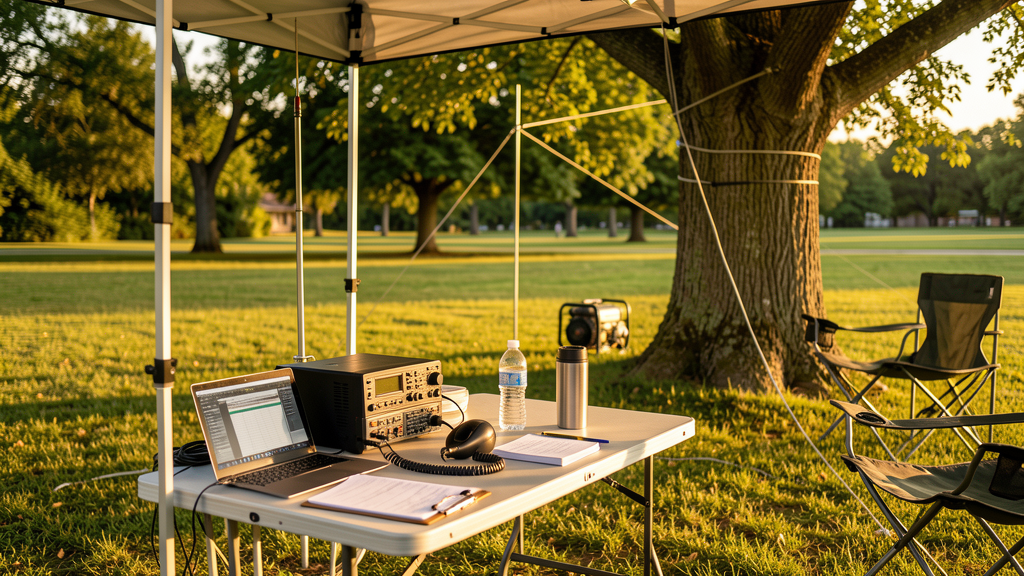
Every June, on the fourth full weekend of the month, something strange happens across America. Tens of thousands of ham radio operators disappear into parks, parking lots, and fairgrounds. They string antennas in trees, run power cables from generators, and operate radios from tents for 24 hours straight.
It’s called Field Day, and it’s the single biggest event in amateur radio every year. If you’ve never been to one, you should know three things upfront: it’s free to attend, you don’t need a license to show up, and it’s one of the easiest doors into this hobby that exists.
ARRL Field Day 2026 runs from 1800 UTC on Saturday, June 27, through 2100 UTC on Sunday, June 28. That’s 27 continuous hours. There will be over 3,000 sites active across the US and Canada, and at least a few of them will be within driving distance of you. Here’s how to actually make sense of it before you show up.
What Field Day Actually Is
Field Day is run by the ARRL (American Radio Relay League) and has happened every year since 1933. It is three events rolled into one weekend: an emergency communications exercise, a nationwide contest, and a public open house.
The emergency exercise is the original purpose. Hams set up temporary radio stations in the field and operate them using emergency power — generators, batteries, solar. The idea is to practice what you’d actually do if the grid was down and normal communications were out. Real hurricanes, wildfires, and tornadoes have happened during Field Day, and operators have pivoted from contesting to passing real traffic.
The contest piece is how clubs keep score. Every contact made gets logged and earns points. Clubs compete for fun and to put their region on the map. The scoring structure is intricate, but you don’t need to know any of it to show up — the contest is for the people running the stations, not the visitors.
The open house is the part that matters to you. Clubs are required to make their sites welcoming to the public as a condition of the event. That means signs, food, and a chair pulled up next to a working radio for anyone who wants to try it.
2025 was one of the biggest years on record — over 3,200 sites and tens of thousands of participants. 2026 will be similar. The “field” part is genuinely the point: tents, trailers, pop-up canopies, wire antennas tossed into trees, generators humming in the background.
The easiest way to think about it: Field Day is ham radio’s biggest annual open house, happening in a park near you this weekend.
Why You Should Show Up Even If You Have No License
You don’t need a license to visit, watch, listen, ask questions, or eat whatever the club is grilling. Field Day is one of the very few ham radio events where the unlicensed public is actively welcomed, not just tolerated.
You can also transmit — under the supervision of a licensed control operator. Most Field Day sites have a station called GOTA (Get On The Air) that exists specifically for newcomers and unlicensed visitors. A licensed ham will hand you a microphone or a Morse code key, help you make a contact, and log it for you. You’ll be on the air without breaking any FCC rules, and you’ll have done something real by the time you leave.
This matters for a reason. Buying a radio and figuring out if you actually like this hobby can be expensive and slow. Field Day is the cheapest, fastest way to find out. You’ll hear what ham radio actually sounds like in the wild, see what the equipment looks like in person, and meet the people who are already doing it — none of which a YouTube video or product review can replicate.
It’s also the lowest-friction way to meet your local ham community. Every club in your area is going to be there. The people who show up are the ones who love talking about radio and love explaining it to newcomers. If you ever wanted a friendly elmer (ham-speak for a mentor), Field Day is where you find one in person.
Entry is free. Food is usually a small donation or a potluck. The whole family can come — kids, spouses, curious neighbors. No special equipment, no experience required.
Ham radio is a hobby best learned in person. Field Day is the easiest in-person door to walk through.
How to Find a Field Day Site Near You
The ARRL publishes an official Field Day site locator in the two weeks leading up to the event. It lists every registered site with its address, the club running it, contact info, and a public contact for visitors. That’s the first place to check.
If the locator doesn’t have what you need yet, a few backup paths usually work:
Google “[your city] ham radio club.” Almost every metro area has at least one active club, and most of them run a Field Day site. The club’s website will usually have a Field Day page up by mid-June with the address, schedule, and a contact email.
Reddit r/HamRadio. Search your city or state plus “Field Day.” Local hams will have already started threads about where their site is.
QRZ.com club search. Filter by location to find active clubs. Their websites will point you to the Field Day site.
Just ask on a repeater. If you have a radio and you can hit a local repeater, the weekly nets in the two weeks before Field Day are full of operators talking about where their site is. Ask once, and you’ll get a half-dozen answers.
What does a Field Day site look like from the outside? Usually a public park, school parking lot, church grounds, emergency operations center (EOC) building, fairgrounds, or sometimes a member’s farm. You’ll see antennas and tents in the distance. Most metro areas have three to ten sites within a 30-minute drive — you’re closer to one than you think.
When you find a site, email or call the contact listed. They’ll be happy to hear from a newcomer, and they’ll usually tell you the best time to arrive.
What You’ll Actually See When You Arrive
The first thing that hits you is the antennas. Temporary dipoles strung between trees. Verticals on push-up masts. Sometimes a beam antenna bolted to a trailer hitch and aimed at the sky. The whole point of Field Day is operating away from permanent infrastructure, so you’ll see antennas in places that look ridiculous — across a parking lot, over a picnic shelter, taped to a fence post. It works. That’s the fun of it.
The second thing you’ll notice is the tent city. Most sites have multiple operating positions, each running a different mode. They look like a small field command post:
Phone tent (SSB voice). This is the loudest one. Two or three operators at microphones, calling out callsigns, working contacts back-to-back. The “CQ Field Day, CQ Field Day” call is unmistakable once you hear it.
CW tent (Morse code). The quietest. Operators tapping keys, headsets on, paper or screen logging each contact. If you’ve never heard live CW, this is the place to do it.
Digital tent (FT8, FT4, RTTY). The one with the laptops. Operators are barely talking — most of the work is happening on screens, with audio that sounds like fax machines to an untrained ear.
Satellite tent. If the site has one, it’s usually a small setup with a directional antenna on a tripod pointed at the sky. The contacts are short and the timing matters — you only have the few minutes a satellite is overhead.
GOTA station. The one for you. Often a simpler rig, sometimes a club member’s spare station, set up specifically for unlicensed visitors and newly licensed hams to make contacts under supervision.
Around the tents you’ll see generators humming, batteries on picnic tables, coax cables running everywhere, and a small fleet of logging stations — paper forms and laptops — where every contact gets recorded for the contest scoring.
There’s usually a welcome table with a sign-in sheet near the entrance. Just walk up, sign in, and say “I’ve never been to one of these.” Someone will hand you off to a club member who will show you around.
And there’s food. Most clubs do a potluck, a Saturday lunch, a Saturday dinner, and a Sunday breakfast. BBQ, chili, hot dogs, pizza — depends on the club. Plan to eat.
What You Can Actually Do There
You have more options than you’d expect.
Watch and listen. Zero commitment, totally fine. Sit in a chair near an operating tent and just observe. You’ll learn more in 20 minutes here than from a week of reading.
Get a tour. Ask and someone will walk you through every station. Most operators love showing off their setup, especially when the visitor is asking real questions.
Make a contact at the GOTA station. This is the headline experience. A licensed control operator will help you transmit — voice, CW, or digital — and log a contact for you. You will have made a real radio contact by the time you leave.
Try Morse code on a real keyer. Most CW operators are happy to let you send a few characters on their straight key or paddle. No license needed; no expectation that you know what you’re doing.
See digital modes in action. Watch FT8 contacts get made in a 15-second exchange. It’s a different kind of operating than voice and worth seeing live.
Ask anything. Literally any question. Hams love explaining their setups, their antennas, why they picked the gear they did, and how they got licensed. This is the part of the hobby the internet can’t replace.
Eat, hang out, and meet the local ham community. The social part is the point. The contacts get logged, the antennas come down, and the people are the part you remember.
How to Prepare (the only checklist you need)
Field Day is meant to be casual. Don’t overthink the prep.
Bring: A folding camp chair. A water bottle. Sunscreen and a hat. A snack to share if you want, but it’s not required. A notebook if you want to take notes — callsigns, names, gear recommendations, anything. If you already have a license, know your callsign (you’ll get a paper log sheet and need to write it down a lot).
Don’t bring: Your own radio gear. You don’t need any. Nice clothes — it’s a field day, expect grass, dirt, weather. Expectations of becoming an expert by Sunday.
Best time to arrive: Saturday morning, roughly 9 AM to noon. Most clubs are still setting up antennas and stations, so you’ll see how everything gets built. The energy is high, the questions are welcome, and people have time to walk you through things.
Best time to stay: Through Saturday lunch or dinner. That’s when the social peak hits and the operators relax. The contest is well underway, the BBQ is going, and the conversations are easier.
If you can only make a short visit, even an hour is worth it. The GOTA station will usually be active all day Saturday.
Common First-Timer Mistakes
A few things first-timers tend to get wrong. None of them are fatal, but avoiding them makes the day better.
Arriving Friday night. Most sites do a setup shift Friday afternoon, but the bulk of the build happens Saturday morning. If you show up Friday, you’ll mostly be watching a few people solder coax connectors in the dark.
Being too shy to walk up to a station. Hams want to show off their gear. That’s not a joke — they spent weeks planning this and they want to talk about it. Walk up, ask what’s happening, ask why they picked that antenna. The conversation will run itself.
Not asking to use the GOTA station. That’s literally what it’s for. If you want to make a contact, say so. The control operator will walk you through it.
Leaving after 30 minutes. The setup is interesting for the first hour. The interesting part — the people, the food, the late-night operating — happens later. Plan to stay at least through lunch.
Not bringing the family. Kids are welcome, and many clubs have youth-oriented activities. Spouses who aren’t hams often have a great time too — the food helps. Don’t make this a solo trip if you don’t have to.
Wearing nice clothes. It is a field event. Lawn chair, closed-toe shoes, layers for evening. That’s the dress code.
Not exchanging contact info with anyone. Get callsigns. Get club websites. Find out when the next club meeting is. Most of the value of Field Day is in the people you meet and the follow-up that happens later.
After Field Day: Your Next Steps
If Field Day lit a spark, here’s how to keep it going.
Got the bug? Study for your Technician license. The Technician exam is 35 multiple-choice questions, the entry point into ham radio, and it gives you real on-air privileges. Our free study course walks you through how to pass it the first time. HamStudy.org has free practice exams using the actual question pool. If you prefer video, our YouTube guide walks you through the whole process.
Met a local club? Go to their next monthly meeting. Most clubs welcome visitors and have a “what’s coming up” calendar that gives you a feel for the local operating scene.
Made a contact at GOTA? Write down the callsign of the control operator. Look them up on QRZ.com. Send them an email saying thanks. That single follow-up email is often the start of a real mentorship relationship.
Want to volunteer next year? Field Day sites always need help with setup, food, logging, and tear-down. Most clubs will gladly take a willing volunteer, and showing up Friday afternoon to help build is the fastest way to actually learn how a station works.
Did nothing else? Come back next year. Field Day happens every year, same weekend, same purpose. Most of the regulars will remember you.
Frequently Asked Questions
Field Day 2026 is June 27-28. Pick a site this week. Show up Saturday morning. Make one contact under supervision at the GOTA station. See what you think. That’s the whole assignment.
Join thousands of new hams who are confidently getting on the air. This practical video series gives you clear solutions to the most common beginner challenges — 100% free with instant access.
Affiliate Disclaimer
Keep in mind that we may receive commissions when you click our links and make purchases. However, this does not impact our reviews and comparisons. We try our best to keep things fair and balanced, in order to help you make the best choice.
As an Amazon Associate, we earn from qualifying purchases.